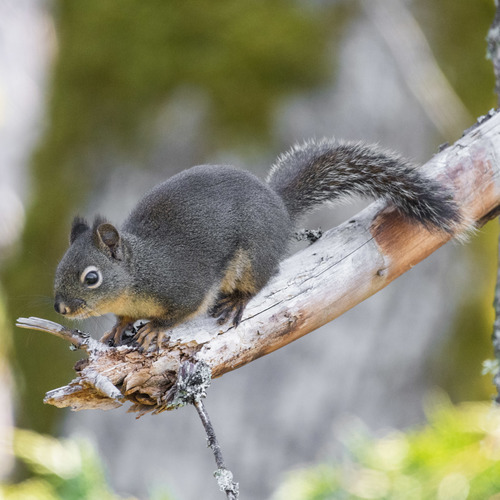
Douglas's Squirrel
Tamiasciurus douglasii
The feisty 'chickaree' of the Pacific Northwest, the Douglas's squirrel is a bolt of orange lightning in the evergreen canopy. A tireless architect of the forest, it spends its days guarding massive cone caches and scolding any who dare to intrude.
Quick Identification
Size
Length: 27–35 cm (10.5–13.5 in); Weight: 150–300 g (5.3–10.6 oz)
Colors
Olive-gray to reddish-brown upperparts; vibrant orange to yellowish underbelly; distinct white eye-ring; dark lateral stripe visible in summer
Key Features
- Vivid orange or yellow belly
- Distinct white eye-rings around dark eyes
- Small, tufted ears in winter
- Noisy, bird-like scolding call
- Bushy tail with dark/frosted tips
When You’ll See Them
Geographic range
Where Does the Douglas's Squirrel Live?
Native to the Pacific Northwest of North America, the Douglas's squirrel is a quintessential inhabitant of the coastal and mountain evergreen forests. Its core range extends from southwestern British Columbia down through Washington and Oregon into the Sierra Nevada mountains of central California. Small, isolated populations are also found in the high-elevation forests of northern Baja California, Mexico, marking the southern limit of its distribution.
Basemap © OpenStreetMap contributors
Behavior
These squirrels are arboreal masters, spent much of their time in the canopy of coniferous trees. They exhibit a unique foraging behavior called 'cone-cutting,' where they nip green cones from branches and drop them to the forest floor to be collected and stored in moist, cool piles to keep the seeds from drying out. They are solitary and can be surprisingly aggressive, often chasing away much larger squirrels or birds from their prized food stores.
EverydayEarth exclusive
Camera Tips
To capture the Douglas's squirrel on your backyard camera, focus your efforts on 'middens'—large, messy piles of cone scales usually located at the base of a mature fir or pine tree. These are the squirrel's primary larders and activity hubs. Mount your camera at a low angle, roughly 1 to 2 feet off the ground, directed toward a flat log or a cleared patch of ground near the midden. Because these squirrels are extremely fast and twitchy, set your camera to a high trigger speed and use a 'burst' or 'multi-shot' mode to ensure you catch more than just a blurry tail.
Baiting can be very effective for bringing them into a specific frame. Use raw, unsalted sunflower seeds, hazelnuts, or walnuts. Instead of a standard bird feeder, try placing the nuts on a natural platform like a stump or a flat rock to get more 'wild' looking shots. If you have a trail camera with a macro focus or adjustable focal length, set it for about 3-5 feet to capture the intricate details of their orange fur and white eye-rings.
Seasonally, winter provides some of the best photographic opportunities. Because Douglas's squirrels do not hibernate, they are often the only active mammals in a snowy landscape. Their vibrant orange bellies provide a stunning contrast against the white snow. During these colder months, their ear tufts are also more prominent, giving them a distinctively 'wild' look. Early morning light is your best friend, as they are most active right after sunrise when they emerge to check their food caches.
Similar Species
Species that look similar or are commonly confused with Douglas's Squirrel.
Frequently Asked Questions
Record Douglas's Squirrel at your habitat
Connect a camera to start building your own species record — AI identifies every visitor automatically.