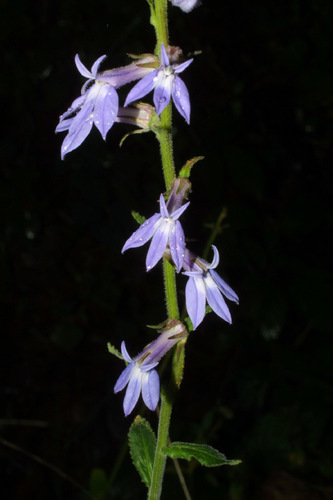
downy lobelia
Lobelia puberula
A late-season jewel of the American South, Downy Lobelia stands tall with velvety stems and striking blue-violet blooms. This hardy perennial is a vital nectar bridge for pollinators preparing for the colder months.
Quick Identification
Size
Stands 1–4 feet (30–120 cm) tall with a narrow spread of about 6–12 inches (15–30 cm)
Colors
Lavender-blue to violet flowers with white throats; stems and foliage are a soft, muted green
Key Features
- Spikes of tubular blue flowers with a three-lobed lower lip
- Stems and leaves covered in soft, fine white hairs (pubescence)
- Tall, unbranched upright growth habit
- Blooms from the bottom of the stalk upward
When You’ll See Them
Geographic range
Where Does the downy lobelia Live?
Native to the North American continent, Downy Lobelia is a quintessential wildflower of the eastern and south-central United States. Its territory extends from the Atlantic coast as far north as New Jersey and Pennsylvania, stretching south through Florida and westward into the humid regions of Texas, Oklahoma, and Arkansas. It is the most frequent blue-flowered lobelia encountered in the Southeastern states, thriving in the humid Coastal Plain and Piedmont regions.
Basemap © OpenStreetMap contributors
Behavior
Downy Lobelia is a perennial wildflower known for its late-season peak, providing a critical nectar source when many other summer flowers have faded. It grows as a low-profile basal rosette during the early spring and summer, eventually sending up a sturdy, velvet-textured flowering spike in the late summer or early fall. Unlike some of its floppier relatives, the Downy Lobelia is notably stiff and upright, holding its own against autumn winds.
In the ecosystem, this plant acts as a specialized landing pad for pollinators. Its flowers are designed with a structural 'lip' that accommodates bumblebees and other long-tongued bees. As the bee enters the flower to reach the nectar, the plant’s reproductive organs brush against the insect's back, ensuring efficient cross-pollination. While it does not 'behave' in an active sense, its presence often dictates the activity of local insect populations during the transition into winter.
EverydayEarth exclusive
Camera Tips
To capture the best images of Downy Lobelia with an AI-powered camera, placement is everything. Position your camera on a short stake or tripod at 'flower level'—typically 24 to 30 inches off the ground. Because these plants grow in damp soil, ensure your camera housing is moisture-resistant. Aim the lens at a cluster of fully opened blooms, which usually start at the bottom of the spike. A side-on angle is best to showcase the fine, silvery hairs on the stem that give the 'Downy' Lobelia its name.
For those looking to capture wildlife interaction, set your camera to a fast trigger speed or high-frame-rate video mode. This species is a favorite of bumblebees and the occasional hummingbird. Since the plant is most active during the day, configure your camera to trigger only during daylight hours to save battery. The best light occurs during the early morning 'golden hour' when backlighting can make the pubescent (hairy) stems appear to glow against a darker forest background.
If you are setting up a trail camera in a backyard or meadow, look for a spot where the soil stays naturally moist. You don't need lures for this species; the vibrant blue color is a natural beacon. However, clearing away tall grasses immediately in front of the lens will prevent the camera from mis-triggering during windy days and ensure the focus stays sharp on the delicate violet petals.
Similar Species
Species that look similar or are commonly confused with downy lobelia.
Frequently Asked Questions
Record downy lobelia at your habitat
Connect a camera to start building your own species record — AI identifies every visitor automatically.