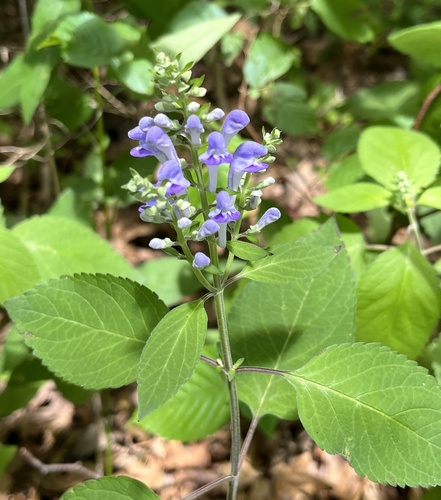
Downy Skullcap
Scutellaria incana
A midsummer gem of the North American woods, the Downy Skullcap dazzles with velvety silver stems and striking purple blooms. This resilient perennial is a favorite for backyard naturalists looking to support local pollinators.
Quick Identification
Size
60-90 cm (2-3 feet) in height; flowers 2-2.5 cm (0.75-1 inch) long
Colors
Lavender-blue to deep purple flowers; grayish-green foliage and stems due to fine white hairs
Key Features
- Square stems covered in fine, downy white hairs
- Two-lipped tubular blue flowers with a distinctive cap-like calyx
- Opposite, ovate leaves with coarsely serrated margins
When You’ll See Them
Geographic range
Where Does the Downy Skullcap Live?
Native to the North American continent, Downy Skullcap is a quintessential inhabitant of the Eastern and Midwestern United States. Its natural range extends from the lower reaches of New York and Pennsylvania, sweeping southward into Florida and westward toward the edges of the Great Plains in Kansas and Oklahoma. It is particularly abundant in the Appalachian and Ozark regions, where it thrives in the dappled light of deciduous forest clearings.
Basemap © OpenStreetMap contributors
Behavior
Downy Skullcap is a hardy, upright perennial that brings structural elegance to the mid-to-late summer landscape. Unlike many woodland wildflowers that bloom in the spring and disappear, this species is known for its stamina, holding its blooms for several weeks. It is a social plant in the botanical sense, often found in small colonies where its rhizomatous root system allows it to spread gently without becoming invasive.
As a member of the mint family, it possesses the characteristic square stem but lacks the strong aromatic scent of its cousins like peppermint. In a garden or wild setting, it acts as a primary nectar source for long-tongued bees. It is remarkably resilient against deer and rabbits, who typically avoid the bitter compounds in its leaves, making it a reliable choice for suburban backyards where herbivory is a common challenge.
EverydayEarth exclusive
Camera Tips
To successfully capture Downy Skullcap on a backyard camera, focus on the 'micro-wildlife' it attracts. Place your camera on a short tripod or stake about 2 feet off the ground, angled slightly downward toward the flower spikes. Because the flowers are relatively small, a camera with a close-focusing distance or a dedicated macro lens will yield the best results for seeing the intricate 'skullcap' structure of the calyx.
Lighting is the biggest challenge when photographing this species in its natural woodland habitat. Direct, midday sun can wash out the delicate lavender hues of the petals. Aim to position your camera so the plant is backlit or in even shade. If your camera allows for exposure adjustment, slightly underexposing can help saturate the deep blues and purples of the blooms.
Since the primary goal is often to see the pollinators, use a high-speed trigger or 'Burst Mode.' Downy Skullcap is a favorite of bumblebees, honeybees, and clearwing moths. Set your motion sensitivity to high, as the weight of a landing bee is often enough to trigger the sensor if the plant is moving. A 3-shot burst will ensure you get a clear frame of the insect entering the flower tube.
For a unique perspective, leave the camera in place after the flowers fall. The seed pods of Downy Skullcap are fascinating—they look like tiny medieval helmets. Using a time-lapse setting (one photo every 4-6 hours) can document the transition from the vibrant purple summer bloom to the structural brown seed heads that persist into the autumn.
Similar Species
Species that look similar or are commonly confused with Downy Skullcap.
Frequently Asked Questions
Record Downy Skullcap at your habitat
Connect a camera to start building your own species record — AI identifies every visitor automatically.