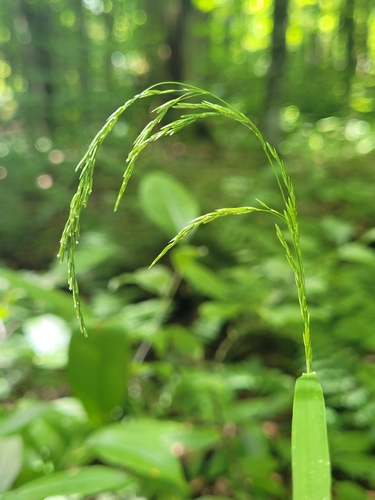
drooping woodreed
Cinna latifolia
An elegant, towering grass of the deep woods, dropping woodreed is famous for its lacy, shimmering seed clusters that bow gracefully toward the damp forest floor. It is an essential component of healthy northern ecosystems, providing both architectural beauty and vital shelter for forest wildlife.
Quick Identification
Size
Stems reach 1 to 2 meters (3.3 to 6.5 feet) in height; leaf blades are 10 to 15 mm (0.4 to 0.6 inches) wide.
Colors
Bright green to lime green foliage; flower clusters are pale green, often with subtle purple or gray tints.
Key Features
- Tall, slender stems reaching up to 2 meters
- Large, drooping, open-branched flower clusters (panicles)
- Prominent, translucent ligules 6-12mm long
- Wide, flat leaf blades with a rough texture
- Single-flowered spikelets that shimmer in the wind
When You’ll See Them
Geographic range
Where Does the drooping woodreed Live?
Dropping woodreed is a truly global traveler of the northern latitudes, possessing a circumboreal distribution that spans the cold-temperate regions of the Northern Hemisphere. In North America, its native range stretches from Alaska across the Canadian wilderness to Newfoundland, dipping south into the United States along the cool, moist corridors of the Rocky Mountains and the Appalachians. Beyond the Americas, it is widely distributed across the northern forests of Europe and Asia, from Scandinavia and Russia to Japan, thriving wherever the soil remains consistently damp and the canopy provides relief from the direct sun.
Basemap © OpenStreetMap contributors
Behavior
Dropping woodreed is a perennial bunchgrass that brings a sense of architectural grace to the damp, shaded corners of the forest. Unlike many aggressive meadow grasses, this species grows in stately, individual clumps that do not crowd out neighboring flora. Throughout the spring and early summer, it focuses its energy on developing broad, lush leaves that serve as a critical micro-habitat for amphibians and ground-nesting insects seeking relief from the heat.
By late summer, the plant undergoes a dramatic transformation, sending up tall, reed-like stalks topped with lacy, airy seed heads. These panicles are exceptionally flexible; as the seeds mature, the weight causes the branches to arch and droop, giving the plant its distinctive silhouette. This grass is wind-pollinated, relying on the gentle air currents of the forest understory to carry its pollen between widely spaced individuals. In the fall, the plant turns a golden straw color before collapsing under the weight of winter snow, contributing rich organic matter back into the soil.
EverydayEarth exclusive
Camera Tips
Capturing dropping woodreed on a trail camera requires a departure from standard animal-tracking setups. Because plants do not generate the body heat required to trigger a Passive Infrared (PIR) sensor, you must use your camera's 'Time Lapse' or 'Field Scan' mode. Set the camera to take an image every 15 to 30 minutes during the day. This setup allows you to create a stunning visual record of the grass growing and the dramatic 'drooping' of the seed heads as they develop in late August.
For the most aesthetic shots, mount your camera at a low height—roughly 2 feet off the ground—and angle it slightly upward. This 'worm’s-eye view' emphasizes the height of the woodreed and captures the translucent quality of the leaves and spikelets against the forest canopy. Positioning the camera so that it faces toward the morning or evening sun can result in beautiful backlighting, making the airy seed clusters appear to glow or shimmer.
Since dropping woodreed thrives in moist areas, consider the humidity when placing your gear. Ensure your camera has a fresh desiccant pack inside the housing to prevent lens fogging in the damp riverbank or forest floor environments where this grass lives. If you are interested in the wildlife that interacts with the grass, place the camera in 'Hybrid Mode' (Time Lapse + Motion Trigger). You may catch forest birds like sparrows or finches landing on the sturdy stalks to harvest the seeds in the early autumn.
Frequently Asked Questions
Record drooping woodreed at your habitat
Connect a camera to start building your own species record — AI identifies every visitor automatically.