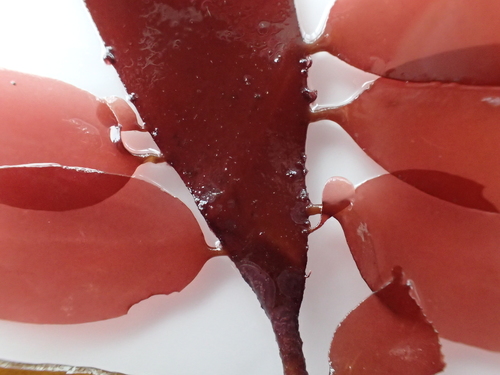
Dulse
Palmaria palmata
Dulse is a striking crimson seaweed with leathery, hand-shaped fronds that has been a staple of North Atlantic coastal life for millennia. This resilient alga thrives in the rhythmic surge of the tides, providing both a nutritious snack for humans and a vital shelter for marine creatures.
Quick Identification
Size
Fronds typically measure 15–50 cm (6–20 inches) in length and 3–8 cm (1–3 inches) in width.
Colors
Deep reddish-purple, crimson, or dark burgundy; can appear translucent or brownish when old.
Key Features
- Flat, leathery palm-shaped fronds
- Small discoid holdfast for rock attachment
- Dichotomous branching from the base
- Translucent deep red color when held to light
When You’ll See Them
Geographic range
Where Does the Dulse Live?
Where Does the Dulse Live? This hardy red alga is native to the cold, nutrient-rich waters of the Northern Hemisphere, primarily colonizing the rocky coasts of the North Atlantic and North Pacific. Its core range includes the shores of the British Isles, Ireland, Iceland, and Northern Europe, extending down to the coast of France. In North America, it thrives from the Canadian Maritimes down to the mid-Atlantic United States, and it is also found along the northern shores of Japan and Korea in the Pacific.
Basemap © OpenStreetMap contributors
Behavior
Dulse is a perennial red alga that spends its life anchored to hard surfaces in the turbulent intertidal zone. While it does not 'behave' in the sense of animal movement, it exhibits remarkable biological resilience, alternating between being completely submerged in cold seawater and exposed to the drying air during low tide. When submerged, the fronds fan out to maximize surface area for photosynthesis and nutrient absorption; when exposed, they go limp and drape over rocks to conserve moisture.
As a foundational species in coastal ecosystems, Dulse provides essential services to marine life. It creates a 'canopy' at a miniature scale, offering shade and humidity to small invertebrates like periwinkles, scuds, and juvenile crabs that hide beneath its damp fronds. It also serves as a substrate for other smaller algae and bryozoans, forming a complex, multi-layered community on a single rocky outcrop.
EverydayEarth exclusive
Camera Tips
Capturing high-quality footage of Dulse requires a waterproof camera setup, such as an action camera or a trail camera in a specialized submersible housing. Because Dulse is stationary and its 'movements' are dictated by the tide, the most compelling footage comes from time-lapse photography. Mount your camera securely to a heavy rock or a pier piling using a clamp or suction mount at the low-tide mark. Setting the camera to take a photo every 30 seconds as the tide comes in will capture the beautiful moment the limp, dark fronds are lifted and unfurled by the water, transforming into a vibrant, swaying crimson garden.
Lighting is critical for bringing out the deep reds of the alga. The best color saturation occurs during 'golden hour'—the hour after sunrise or before sunset—when the low angle of the sun penetrates the shallow water or illuminates the wet fronds on the rocks without the harsh glare of midday. If you are shooting underwater in a tide pool, try to position the camera so the sun is behind you, lighting up the translucent blades from the front to show their internal structure and palm-like branching.
Focus on the details by using a macro lens or setting your camera to its closest focusing distance. Dulse is often a host to a miniature world of biodiversity; look for small sea snails (Littorina) crawling across the blades or tiny crustaceans darting in and out of the holdfast. Using a high frame rate (60fps or higher) for video can help you capture the hypnotic, rhythmic swaying of the fronds in the surge, which creates a calming and professional-looking cinematic effect.
Finally, always prioritize camera safety and environmental ethics. Ensure your mounting hardware doesn't damage the rock surface or crush other living organisms. Check the tide charts carefully before setting your camera; you want to ensure the camera is placed during a receding tide so you can safely retrieve it before the water gets too deep. If you are monitoring a backyard coastal area, look for Dulse in sheltered inlets where the water is cleaner and less prone to heavy silt, which can cloud your lens.
Similar Species
Species that look similar or are commonly confused with Dulse.
Frequently Asked Questions
Record Dulse at your habitat
Connect a camera to start building your own species record — AI identifies every visitor automatically.