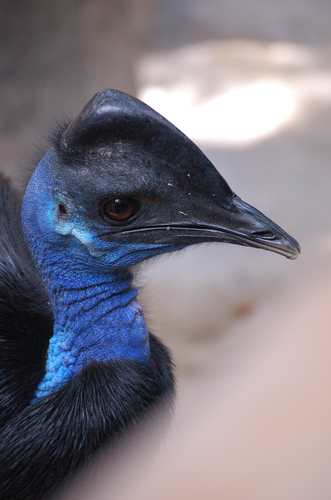
Dwarf Cassowary
Casuarius bennetti
The Dwarf Cassowary is a living relic of the prehistoric world, a solitary 'mountain muruk' that haunts the misty highlands of New Guinea. Though smaller than its cousins, it remains one of the most striking and mysterious birds on the planet.
Quick Identification
Size
Height: 100–110 cm (39–43 in); Weight: 17–26 kg (37–57 lb)
Colors
Glossy black body plumage; vibrant sky-blue skin on the face and neck; violet patches on the side of the neck; no red wattles; dark brown casque.
Key Features
- Smallest of the three cassowary species
- No fleshy red neck wattles
- Flattened, triangular-shaped casque (helmet) on the head
- Bright blue and purple skin on the neck
When You’ll See Them
Geographic range
Where Does the Dwarf Cassowary Live?
The Dwarf Cassowary is native to the rugged islands of the South Pacific, with its core population centered in the mountainous interior of New Guinea. It is also found on the islands of New Britain and Yapen, where it thrives in steep terrain that other large ground birds cannot easily navigate. Because it prefers high-altitude montane environments, its range is naturally fragmented by the deep valleys and soaring peaks of the Central Range.
Basemap © OpenStreetMap contributors
Behavior
Despite their solitary nature, they play a vital role in their ecosystem as seed dispersers. Their social structure is unique; females are the larger, more dominant sex and may mate with multiple males during the breeding season. The male takes on the full responsibility of parental care, incubating the large green eggs for roughly 50 days and raising the striped chicks alone for up to a year.
EverydayEarth exclusive
Camera Tips
Avoid checking your camera too frequently. These birds have exceptional hearing and a keen sense of smell; frequent human activity can cause them to abandon a specific trail for weeks. If you are setting up in a backyard that borders a forest, ensure there is a thick buffer of native vegetation. The birds are unlikely to step into wide-open lawn areas and prefer to stay near the security of the shadows.
Since these birds inhabit high-rainfall environments, use a high-quality waterproof housing and include desiccant packets inside the camera to prevent lens fogging. Setting your camera to 'Burst Mode' (3-5 photos) or short 15-second video clips is highly recommended. Cassowaries move with a rhythmic, bobbing motion that can result in motion blur on slower cameras; a fast trigger speed (under 0.5 seconds) is essential for a clear shot.
If you find a 'fruiting tree'—particularly wild figs or species from the laurel family—this is your best chance for a high-quality capture. Look for scat containing large, undigested seeds on the ground. Position your camera about 10-15 feet away from the fallen fruit to allow for a wide field of view that captures the bird's full stature as it feeds.
Similar Species
Species that look similar or are commonly confused with Dwarf Cassowary.
Frequently Asked Questions
Record Dwarf Cassowary at your habitat
Connect a camera to start building your own species record — AI identifies every visitor automatically.