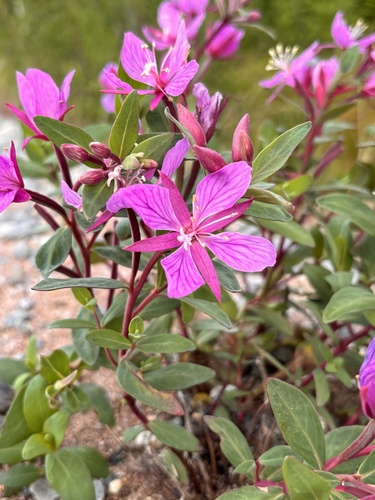
Dwarf Fireweed
Chamaenerion latifolium
The 'River Beauty' of the north, Dwarf Fireweed is a resilient pioneer that paints the rocky Arctic and alpine landscapes with vibrant magenta blooms.
Quick Identification
Size
Height: 10–60 cm (4–24 in); Flower diameter: 2–6 cm (0.8–2.4 in)
Colors
Vibrant magenta to deep pink petals with contrasting dark red sepals; waxy blue-green or grey-green foliage; rare white variants.
Key Features
- Large, four-petaled nodding flowers in clusters
- Waxy, fleshy lance-shaped leaves
- Low-growing, clump-forming habit typically under 2 feet tall
When You’ll See Them
Geographic range
Where Does the Dwarf Fireweed Live?
Native to the vast northern regions of the Northern Hemisphere, Dwarf Fireweed is a true circumboreal specialist. It flourishes across the rugged landscapes of Canada, Alaska, and the high-elevation peaks of the Rocky Mountains in the United States, while also blanketing the Arctic reaches of Greenland, Iceland, Scandinavia, and Northern Russia. It is particularly adept at colonizing areas where glaciers have recently retreated or where snowmelt regularly floods gravelly plains.
Basemap © OpenStreetMap contributors
Behavior
Dwarf Fireweed, also known as River Beauty, is a resilient pioneer species that thrives in the harsh, shifting environments of the far north. Unlike many delicate alpine plants, it is a vigorous grower that uses its woody base to anchor itself against the movement of gravel and rushing meltwater. It is often the first splash of color to appear on barren glacial moraines or flood-prone riverbanks, where it plays a critical role in stabilizing soil and capturing organic matter.
As a key member of its ecosystem, Dwarf Fireweed is a hub of activity for pollinators. During the short Arctic and alpine summers, its large, nectar-rich flowers attract a flurry of bumblebees and hawk moths. Humans have long valued the plant as well; its leaves and flowers are edible and exceptionally high in Vitamin C, making it a traditional food source for Indigenous peoples across the Arctic who often consume it raw or as a tea.
EverydayEarth exclusive
Camera Tips
Capturing the vibrant essence of Dwarf Fireweed requires a strategy focused on macro-details and environmental context. Because this plant thrives in windy alpine and riverine environments, movement is your biggest challenge. Use a tripod and set your camera to a fast shutter speed to freeze the 'nodding' motion of the heavy flower heads. If you are using a trail camera with a macro lens, place it approximately 12 to 18 inches from a healthy clump of blossoms, ensuring the lens is angled slightly upward to capture the interior of the downward-facing petals.
To document the plant’s ecological story, set up your camera to capture time-lapse footage over several days during the peak of July. This is the best way to record the fascinating rhythm of the flowers opening and the subsequent visits from pollinators like bumblebees and clearwing moths. Position the camera so that it catches the low-angled sun of the Arctic or alpine golden hour; the waxy, glaucous leaves have a beautiful blue-green sheen that pops brilliantly against the deep pink petals when back-lit.
Since Dwarf Fireweed often grows on rocky gravel bars or near water, ensure your camera housing is waterproof and well-secured. Rising water levels from summer glacial melt can easily sweep away a poorly anchored setup. If you're looking for the best color saturation, aim for slightly overcast days, which prevent the bright magenta petals from 'blowing out' or losing detail in harsh, direct sunlight. Finally, consider a ground-level 'worm’s eye' perspective to emphasize the plant's resilience against the vast, towering landscape it inhabits.
Similar Species
Species that look similar or are commonly confused with Dwarf Fireweed.
Frequently Asked Questions
Record Dwarf Fireweed at your habitat
Connect a camera to start building your own species record — AI identifies every visitor automatically.