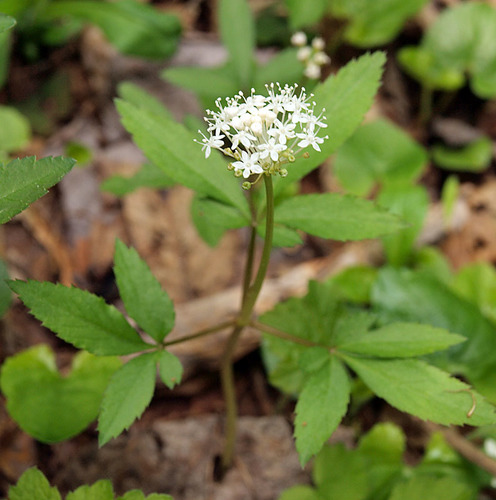
dwarf ginseng
Panax trifolius
A delicate, white-flowered gem of the spring understory, dwarf ginseng is a master of the short-lived forest bloom. This tiny relative of the famous medicinal herb hides in plain sight among the fallen leaves of the Eastern woods.
Quick Identification
Size
A miniature woodland herb reaching only 3 to 8 inches (7.5 to 20 cm) in height with tiny blossoms.
Colors
Bright green leaves; globe-shaped clusters of tiny white or pinkish-white flowers; small yellowish-green berries.
Key Features
- Single spherical cluster of white flowers
- Three compound leaves in a single whorl
- 3 to 5 serrated leaflets per leaf
- Minute stature compared to other ginseng species
When You’ll See Them
Geographic range
Where Does the dwarf ginseng Live?
Dwarf ginseng is native to the temperate forests of Eastern North America. Its primary range stretches from the Canadian provinces of Ontario, Quebec, and Nova Scotia, southward through New England and the Great Lakes region, and follows the Appalachian Mountains down into Northern Georgia. It is a true specialist of the Eastern Deciduous Forest biome, rarely found outside of mature, undisturbed woodland environments.
Basemap © OpenStreetMap contributors
Behavior
Dwarf ginseng is a fascinating spring ephemeral, a group of plants that complete their entire above-ground life cycle in the brief window of sunlight before the forest canopy leaf-out. It emerges from a small, round underground corm as soon as the soil warms in April. One of its most remarkable biological traits is its gender flexibility, known as being diphasic. Smaller plants with fewer energy reserves typically produce only male flowers, while larger, more established plants can produce hermaphroditic flowers that are capable of developing into seeds.
This species is highly synchronized with its environment, often disappearing entirely by early summer as the plant goes dormant to survive the heat and shade of the deep forest. During its short active period, it provides an essential early-season nectar source for specialized pollinators, particularly small hoverflies and solitary bees that are active in the cool spring air. Because it grows in colonies, it often creates a 'carpet' effect on the forest floor, though its small size requires a keen eye to spot.
EverydayEarth exclusive
Camera Tips
Capturing dwarf ginseng on a trail camera requires a specialized setup because the subject is stationary and very low to the ground. Instead of standard motion-triggering, which the plant won't activate, use your camera’s time-lapse mode. Set the interval to one photo every 30 minutes from sunrise to sunset. This will allow you to create a stunning video of the plant growing, the flower cluster unfurling, and the pollinators visiting throughout the day.
Positioning is everything for this species. You must mount your camera at 'mouse-eye level,' no more than 4 to 6 inches off the ground. Use a dedicated ground stake or a small flexible tripod rather than a tree strap. Because the plant is so small, ensure you clear away any dead leaves or twigs that might be between the lens and the plant. Be careful not to disturb the soil around the plant, as their root systems are delicate.
Lighting in a spring forest can be tricky. Try to frame your shot so the ginseng is in a spot that receives 'sun flecks'—the patches of direct light that hit the forest floor through the branches. This provides natural highlighting that makes the white flowers pop against the dark soil. If your camera has a macro or 'close-up' setting, ensure it is engaged to keep the delicate serrations of the leaves in sharp focus. Since these plants yellow and disappear by June, the best window for filming is usually the first three weeks of May.
Similar Species
Species that look similar or are commonly confused with dwarf ginseng.
Frequently Asked Questions
Record dwarf ginseng at your habitat
Connect a camera to start building your own species record — AI identifies every visitor automatically.