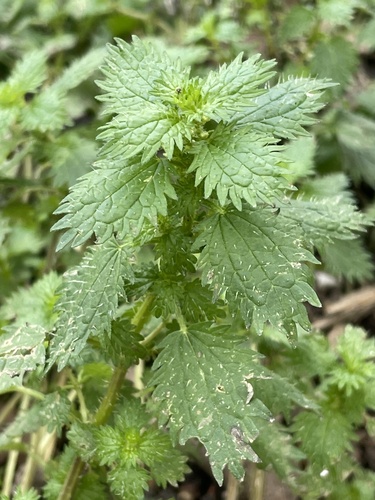
Dwarf Nettle
Urtica urens
Though small in stature, the Dwarf Nettle packs a potent punch with its stinging hairs. This rapid-growing annual is a master of garden colonization and a vital sanctuary for garden butterflies.
Quick Identification
Size
10-60 cm (4-24 inches) in height; leaves 1-4 cm (0.4-1.5 inches) long
Colors
Bright green foliage; greenish-white or pale yellow flower clusters; stems often have a slight translucent or pale green appearance
Key Features
- Ovate, deeply serrated leaves with rounded teeth
- Stinging hairs (trichomes) covering stems and leaves
- Compact annual growth habit, usually under 2 feet tall
- Dense, short flower spikes (axillary clusters) shorter than the leaf stalks
When You’ll See Them
Geographic range
Where Does the Dwarf Nettle Live?
Native to Eurasia and the Himalayan regions of India, the Dwarf Nettle is a cosmopolitan traveler that has successfully naturalized across much of the globe. It is widely established throughout North America, South Africa, Australia, and New Zealand, thriving particularly in temperate climates. As an opportunistic species, its global footprint follows human development, appearing wherever soil is regularly turned or enriched by fertilizers.
Basemap © OpenStreetMap contributors
Behavior
The Dwarf Nettle is an annual herbaceous plant known for its rapid lifecycle and defensive capabilities. Unlike its perennial cousin, the Common Nettle, which spreads via underground rhizomes, this species must grow from seed to maturity within a single growing season. It is a pioneer species, specializing in colonizing disturbed ground where competition from other plants is temporarily reduced. Because it thrives in nitrogen-rich environments, it is often found in close association with human activity, such as in farmyards, vegetable patches, and garden borders.
The plant’s most notable interaction with humans and animals is its sting. The leaves and stems are covered in silica-tipped hairs that break upon contact, acting like tiny needles to inject a blend of irritants including formic acid and histamine. Interestingly, while it causes discomfort to humans, it is a vital host plant for several species of butterflies, such as the Red Admiral and the Small Tortoiseshell. These insects lay their eggs on the leaves so their caterpillars can feed on the foliage, protected by the plant's stinging defenses from larger herbivores.
EverydayEarth exclusive
Camera Tips
Capturing the Dwarf Nettle on your AI-powered backyard camera requires a different approach than filming wildlife. To get a high-quality identification, place your camera at a low 'worm's-eye' view, approximately 6 to 12 inches off the ground. Using a macro lens or a camera with a short focal distance is essential to resolve the fine details of the stinging hairs on the stem and the unique serrated edges of the leaves, which are key for AI identification algorithms.
Since plants don't move like animals, this species is an excellent subject for time-lapse photography. Set your camera to take a photo every hour during daylight for several weeks to witness its rapid growth from a seedling to a flowering adult. Ensure your camera is positioned to avoid direct lens flare from the sun, which can wash out the deep green color of the foliage and confuse the AI's color recognition sensors. A north-facing orientation for the lens is often best to keep the plant evenly lit throughout the day.
For the best clarity, choose a day with 'bright-overcast' lighting. High-contrast midday sun can create harsh shadows that hide the flower clusters in the leaf axils. If your camera triggers on motion, you may want to increase sensitivity or use a 'scheduled capture' mode, as the plant's movement in the wind might not always be enough to trigger a recording. Focus specifically on the junction where the leaf stem meets the main stalk to capture the distinctive flower spikes, as these are the primary feature used to distinguish it from the larger Common Nettle.
Similar Species
Species that look similar or are commonly confused with Dwarf Nettle.
Frequently Asked Questions
Record Dwarf Nettle at your habitat
Connect a camera to start building your own species record — AI identifies every visitor automatically.