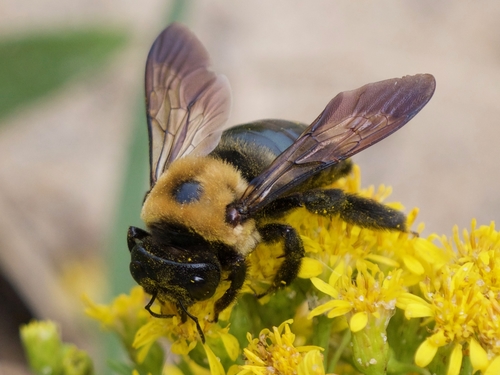
Eastern Carpenter Bee
Xylocopa virginica
Often mistaken for oversized bumblebees, the Eastern Carpenter Bee is a master woodworker and vital pollinator. Recognized by their shiny black tails and curious hovering behavior, these gentle giants are a staple of the backyard ecosystem.
Quick Identification
Size
19–25 mm (0.75–1.0 inches) in length; wingspan of approximately 38–45 mm (1.5–1.75 inches)
Colors
Metallic black abdomen with a smooth, shiny surface; thorax covered in thick yellow-to-tan hairs. Males feature a distinct white or yellowish square patch on their face.
Key Features
- Shiny, hairless black abdomen (unlike fuzzy bumblebees)
- Large, robust body with a yellow fuzzy thorax
- Male has a white/yellow spot on the face
- Hovering, territorial flight pattern near eaves and decks
When You’ll See Them
Geographic range
Where Does the Eastern Carpenter Bee Live?
Native to the North American continent, the Eastern Carpenter Bee is a ubiquitous sight throughout the eastern half of the United States and extends its reach into southern Canada. Its core population spans from the Atlantic coast westward to the Great Plains, thriving in both the humid subtropical environments of the South and the temperate zones of the Northeast. While they are most concentrated in the United States, they have become increasingly common in Ontario and Quebec as they follow human-built wooden structures and warming climates northward.
Basemap © OpenStreetMap contributors
Behavior
The Eastern Carpenter Bee is a fascinating solitary insect often observed hovering around wooden structures like decks, eaves, and fences. While they are technically solitary, they are known as 'gregarious,' meaning several females may nest in the same piece of wood. They are famous for their engineering skills, using their powerful mandibles to vibrate against wood and drill perfectly circular half-inch holes to create nesting galleries.
Males are highly territorial and will frequently 'dive-bomb' or hover inches away from humans who approach their nesting sites. Despite this intimidating behavior, males lack a stinger and are completely harmless. Females do possess a stinger but are exceptionally docile, typically only stinging if handled roughly or stepped upon. They are active during the day and are often the first bees to emerge in early spring.
Unlike many other bees, Eastern Carpenter Bees are notorious 'nectar robbers.' If a flower is too deep for their tongue to reach the nectar, they use their sharp mouthparts to slit the base of the flower and drink the nectar without providing any pollination service to the plant.
EverydayEarth exclusive
Camera Tips
To capture the best footage of Eastern Carpenter Bees, aim your camera at known nesting sites. Look for the characteristic 1/2-inch perfectly round entrance holes in unpainted cedar, pine, or redwood. Mount your AI camera on a tripod approximately 2 to 4 feet away from the entrance, angling it slightly upward to catch the bees as they land and enter the tunnel. Because they are fast-moving, use a high-frame-rate setting if available to capture the detail of their vibrating wings.
If you aren't seeing nesting activity, set your camera near large-blossomed flowers like lavender, salvia, or sunflowers. These bees are 'heavy' and will cause the flowers to dip significantly, which makes for great action shots. Since they are most active during the warmest parts of the day, ensure your camera is positioned to avoid direct lens flare from the high sun while still providing enough light to showcase the metallic sheen of their abdomens.
Don't forget to capture the 'guards.' Male carpenter bees will often hover in one spot for long periods, guarding a nest or territory. This provides an excellent opportunity for high-resolution stills. Position the camera at eye level near the eaves of a shed or a porch railing where you see them hovering; the AI will have an easier time locking focus on a hovering bee than one darting between flowers.
Similar Species
Species that look similar or are commonly confused with Eastern Carpenter Bee.
Frequently Asked Questions
Record Eastern Carpenter Bee at your habitat
Connect a camera to start building your own species record — AI identifies every visitor automatically.