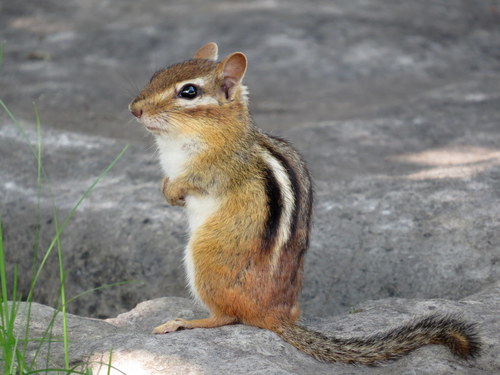
Eastern Chipmunk
Tamias striatus
The Eastern Chipmunk is a tireless worker of the forest floor, easily recognized by its bold stripes and rhythmic 'chip-chip-chip' call. These charismatic rodents transform backyards into bustling construction zones as they build intricate underground homes and gather winter stores.
Quick Identification
Size
Total length 21-30 cm (8-12 inches); weight 66-150 g (2.3-5.3 oz)
Colors
Reddish-brown upper body with five dark longitudinal stripes separated by cream or white; white or buff underbelly; reddish rump.
Key Features
- Five dark stripes along the back and sides
- White stripe bordered by black above and below the eye
- Large internal cheek pouches for food transport
- Stripes end at the reddish-brown rump and do not extend to the tail
When You’ll See Them
Sightings on EverydayEarth
Jun 26, 2026
An Eastern Chipmunk is foraging in the feeder tray, which is filled with a mix of cracked corn and seeds. It moves around the tray, sniffing and sorting through the food with its head down, its characteristic stripes clearly visible from above.
Jun 26, 2026
An Eastern Chipmunk is perched on the edge of the feeder, diligently sorting through the corn and seeds to fill its cheek pouches.
Jun 26, 2026
An Eastern Chipmunk is seen at very close range, foraging through the corn and seed in the feeder tray. It remains focused on feeding, with its distinctive striped back facing the lens for the duration of the clip.
Jun 26, 2026
An Eastern Chipmunk is perched on the edge of the bird feeder tray, actively stuffing its cheek pouches with a variety of seeds. It exhibits characteristic alert behavior, frequently pausing its foraging to look around. In the background, an American Red Squirrel can be seen moving across the lawn near another feeder.
Jun 26, 2026
An Eastern Chipmunk is perched inside the bird feeder tray, actively foraging through the seeds and corn. It can be seen using its paws to sift through the food and likely filling its cheek pouches.
Jun 26, 2026
An Eastern Chipmunk is very active at the feeder, climbing directly into the tray filled with corn and seeds to forage. It moves its tail and head frequently while searching for the best morsels.
Geographic range
Where Does the Eastern Chipmunk Live?
Native to North America, the Eastern Chipmunk is widely distributed throughout the eastern half of the continent. Its core range extends from southeastern Canada across the northeastern and Midwestern United States, reaching as far south as the Gulf Coast states, though it is absent from the Florida peninsula. This adaptable species thrives wherever there is sufficient ground cover, from the deep Appalachian woods to the leafy suburbs of major metropolitan areas.
Basemap © OpenStreetMap contributors
Recorded on EverydayEarth
Behavior
Eastern Chipmunks are energetic, diurnal rodents known for their industrious nature. They spend the majority of their daylight hours foraging for food to store in their extensive underground burrow systems, which can reach over 3 meters (10 feet) in length. While they are expert climbers, they spend most of their time on the forest floor or atop stone walls and fallen logs, which they use as 'lookout' posts and transit highways.
These animals are primarily solitary and highly territorial, often defending their burrow entrances with sharp 'chipping' vocalizations that sound remarkably like bird calls. Although they are not true hibernators, they enter a state of torpor during the winter, waking up every few days to consume the cache of seeds and nuts they spent the autumn collecting.
EverydayEarth exclusive
Camera Tips
To capture the best footage of an Eastern Chipmunk, camera placement is everything. These rodents are ground-dwellers, so your camera should be mounted no more than 3 to 6 inches off the ground. Aiming the lens along a 'natural highway' like the top of a stone wall, a fallen log, or the edge of a garden bed will yield the most consistent results. Because they are small and fast, ensure your camera has a rapid trigger speed—ideally under 0.3 seconds—to avoid capturing nothing but a disappearing tail.
If you are looking to 'bait' a specific spot for your camera, a handful of black oil sunflower seeds or unsalted peanuts placed on a flat, photogenic rock works wonders. This encourages the chipmunk to pause and stuff its cheek pouches, giving you a perfect window for high-quality photos or video. Focus your camera's focal point on the bait station to ensure the fine detail of their fur and whiskers is captured sharply.
Timing is also key for chipmunk photography. They are most active during the early morning and late afternoon when the light is soft, which also helps prevent the high-contrast 'hot spots' that midday sun can cause on their white stripes. During the autumn 'hoarding' season (September and October), their activity levels skyrocket as they prepare for winter, making this the absolute best time to observe their fascinating cheek-filling behavior.
Similar Species
Species that look similar or are commonly confused with Eastern Chipmunk.
Frequently Asked Questions
Record Eastern Chipmunk at your habitat
Connect a camera to start building your own species record — AI identifies every visitor automatically.