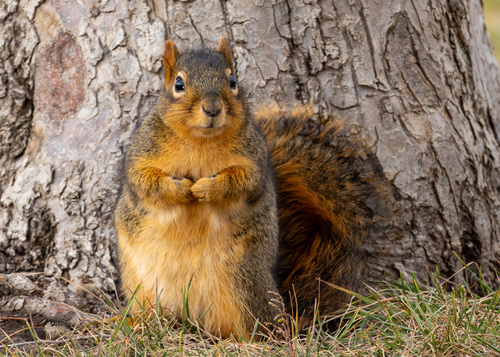
Eastern Fox Squirrel
Sciurus niger
Meet the heavyweight champion of the tree squirrel world. With their vibrant orange bellies and clever personalities, Eastern Fox Squirrels are the bold, acrobatic stars of the American backyard.
Quick Identification
Size
Total length 45–70 cm (17.7–27.6 in); weight 500–1,000 g (1.1–2.2 lbs)
Colors
Grizzled brownish-grey upper parts; distinctive orange to cinnamon-colored underparts; tail is fringed with reddish-orange hairs; some regional populations are entirely black (melanistic).
Key Features
- Largest North American tree squirrel
- Bright orange or buff-colored belly
- Broad, squared-off snout with rounded ears
- Tail is often as long as the head and body combined
When You’ll See Them
Sightings on EverydayEarth
Aug 1, 2026
An Eastern Fox Squirrel forages across the leafy ground of a woodland clearing. It hops forward, pausing several times to sniff the soil and look around before eventually moving off-screen to the right.
Jul 30, 2026
An Eastern Fox Squirrel enters from the right and traverses the forest floor toward the left. It pauses momentarily to look around, showing its distinctive reddish belly and bushy tail, before continuing out of the camera's view.
Jul 30, 2026
An Eastern Fox Squirrel scurries across the sun-dappled forest clearing in the background. It moves quickly from left to right, pausing briefly before disappearing into the undergrowth.
Jul 28, 2026
An Eastern Fox Squirrel is foraging on the forest floor in a clearing, occasionally pausing to stand upright and scan its surroundings before moving toward the tree line.
Jul 25, 2026
An Eastern Fox Squirrel is seen scurrying through the vegetation and leaf litter on the right side of the trail. It moves with a typical hopping gait, pausing briefly in the dappled sunlight before continuing along the edge of the clearing.
Jul 25, 2026
An Eastern Fox Squirrel forages through the leaf litter in the lower right corner of the woodland clearing, moving slowly across the ground.
Geographic range
Where Does the Eastern Fox Squirrel Live?
Native to the North American continent, the Eastern Fox Squirrel's heartland lies within the eastern and central United States, stretching from the Gulf Coast up to the southern Great Lakes. While their native range stops at the edge of the Great Plains, they have established significant introduced populations across the Western United States, including urban and suburban areas in California, Oregon, and Washington. They are also found in the southern reaches of Canada and the northernmost states of Mexico, demonstrating a remarkable ability to thrive in both temperate and subtropical climates.
Basemap © OpenStreetMap contributors
Recorded on EverydayEarth
Behavior
The Eastern Fox Squirrel is a charismatic and somewhat bold presence in backyards across North America. Unlike many other tree squirrels that stick strictly to the canopy, they are surprisingly comfortable spending significant amounts of time on the ground, often foraging through leaf litter for several hours a day. They are generally solitary, though they possess a 'live and let live' attitude toward other squirrels unless food is scarce or it is the height of the mating season.
These squirrels are masters of spatial memory, utilizing a 'scatter-hoarding' strategy where they bury thousands of individual nuts each autumn to survive the winter. Their social interactions are often communicated through tail-flicking and a variety of vocalizations, including 'chucks' and 'wheezes' used to warn the neighborhood of predators like hawks or house cats. To humans, they are often seen as less frantic and more approachable than their smaller gray cousins, frequently becoming 'regulars' at backyard feeding stations.
EverydayEarth exclusive
Camera Tips
Because Eastern Fox Squirrels are significantly larger and spend more time on the ground than other squirrel species, camera placement is most effective when positioned low. Aim your camera at the base of a mature oak or walnut tree, or along a wooden fence rail about 2 to 3 feet off the ground. A wide-angle lens or a camera with a generous field of view is preferred to capture their full, bushy tail, which can be nearly 14 inches long. If you are using a trail camera, a mounting height of 12-18 inches (30-45 cm) angled slightly upward often produces the most dramatic 'wildlife portrait' style shots.
To guarantee a visit, use a combination of whole walnuts, pecans, or dried corn. Unlike many birds, fox squirrels have a keen sense of smell and will be quickly drawn to the scent of cracked nuts. If you want them to linger in front of the lens rather than just grabbing a snack and running, try a 'squirrel jar' or a specialized feeder that requires a bit of effort to open; this keeps them in the frame longer. Be sure to place your camera in a spot that receives good morning light, as they are early risers and are most active shortly after sunrise.
For technical settings, prioritize a fast shutter speed or a high-frame-rate video mode. While Fox Squirrels appear more deliberate and less 'twitchy' than smaller species, they are prone to sudden, explosive movements if they hear a bird of prey or a barking dog. If your AI-powered camera has a 'burst' mode, set it to take 3-5 photos per trigger to capture the perfect mid-jump or tail-flick moment. During the winter months, their activity doesn't stop, but they may shift their peak hours to the warmest part of the mid-afternoon, so ensure your camera has fresh batteries for cold-weather operation.
Similar Species
Species that look similar or are commonly confused with Eastern Fox Squirrel.
Eastern Gray Squirrel
Smaller with a white belly and a more 'twitchy' temperament; lacks the orange-cinnamon tones of the Fox Squirrel.
American Red Squirrel
Much smaller (about half the size) with a white eye-ring and a preference for coniferous forests.
Abert's Squirrel
Found in the Southwest, this species has distinctive long ear tufts which Fox Squirrels never possess.
Frequently Asked Questions
Record Eastern Fox Squirrel at your habitat
Connect a camera to start building your own species record — AI identifies every visitor automatically.