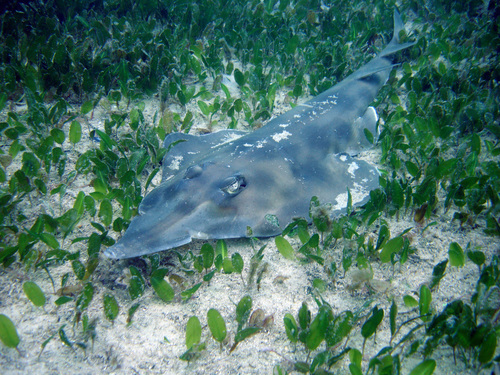
Eastern Shovelnose Ray
Aptychotrema rostrata
The Eastern Shovelnose Ray is a captivating 'living fossil' that bridges the gap between sharks and rays. With its iconic flattened snout and graceful gliding motion, it is the silent sentinel of Australia's sandy estuaries.
Quick Identification
Size
Typically 60–100 cm (24–39 in) in length, reaching a maximum of 120 cm (47 in). Weights generally range from 2–6 kg (4.4–13.2 lbs).
Colors
Dorsal surface is sandy brown, olive, or yellowish-grey, often sprinkled with small, dark blotches or spots; the underside is uniform white or cream.
Key Features
- Distinctive elongated, shovel-shaped snout
- Flattened, guitar-like body transitioning into a thick shark-like tail
- Two large, equal-sized dorsal fins located well behind the pelvic fins
- Rows of small, blunt teeth suited for crushing shells
- Eyes positioned on top of the head with prominent spiracles behind them
When You’ll See Them
Geographic range
Where Does the Eastern Shovelnose Ray Live?
The Eastern Shovelnose Ray is a proud Australian local, found exclusively along the eastern coastline of the continent. Its core territory stretches from the warm, subtropical waters of southern Queensland down through the temperate regions of New South Wales. These rays are particularly abundant in large estuarine systems like Moreton Bay and Botany Bay, where sandy bottoms provide the perfect environment for their bottom-dwelling lifestyle.
Basemap © OpenStreetMap contributors
Behavior
The Eastern Shovelnose Ray is a masters of camouflage, often spending its daylight hours partially buried under a thin layer of sand or silt. This sedentary lifestyle allows them to remain invisible to predators and unsuspecting prey alike. While they may appear sluggish, they are capable of sudden bursts of speed, using their powerful tails to propel themselves across the seabed when disturbed or when chasing a meal.
These rays are generally solitary but can be found in high concentrations in areas with abundant food or during breeding seasons. They are remarkably docile toward humans and are a common sight for snorkelers in shallow estuaries. Unlike stingrays, they lack a venomous barb, making them one of the safer large fish to observe in the wild, though they should still be treated with respect and space.
EverydayEarth exclusive
Camera Tips
Capturing the Eastern Shovelnose Ray requires a specialized approach, as these are strictly aquatic animals. For those with waterfront backyards on canals or estuaries, an underwater AI camera mounted to a jetty pylon or a weighted seafloor tripod is ideal. Position the camera about 30 to 50 centimeters above the sandy floor, angled slightly downward to capture the ray's unique profile as it glides over the substrate.
Because these rays rely on their sense of smell, using a 'scent station' can be highly effective. A small, perforated PVC tube filled with crushed sardines or oily fish scraps (burley) placed just inside the camera's field of view will often lure them in. They are curious and will frequently nudge the bait station, providing excellent close-up footage of their shovel-shaped snouts and underside mouth structures.
Timing is critical; configure your camera to trigger more frequently during the 'golden hours' of the incoming tide, as the moving water brings in nutrients and prompts the rays to hunt. Since they often bury themselves, look for 'shovelnose pits' in the sand—u-shaped depressions that indicate a ray was recently resting there. Placing your camera near these spots increases your chances of a sighting.
Lighting can be a challenge underwater. If your AI camera has infrared capabilities, it will work well for night captures when the rays are most active. For daytime shots, try to position the camera so the sun is behind it to avoid glare from the water's surface, and ensure the lens is cleaned weekly to remove algae or barnacle growth that can confuse motion detection sensors.
Frequently Asked Questions
Record Eastern Shovelnose Ray at your habitat
Connect a camera to start building your own species record — AI identifies every visitor automatically.