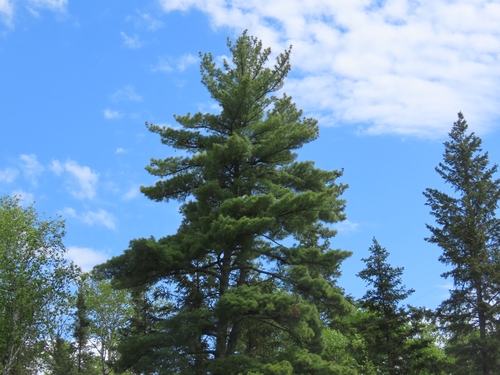
eastern white pine
Pinus strobus
The 'Monarch of the North,' the eastern white pine is a towering evergreen icon that provides year-round sanctuary for backyard wildlife.
Quick Identification
Size
Height typically 30–50 meters (100–160 feet); trunk diameter 0.6–1.2 meters (2–4 feet)
Colors
Bluish-green needles with white stomatal lines; grayish-brown deeply furrowed bark on mature trees; light brown resinous cones
Key Features
- Soft needles in bundles of five
- Long, slender, curved cones (3-6 inches) without prickles
- Branches grow in distinct annual whorls
- Straight, tall trunk with a pyramid-shaped crown in youth
When You’ll See Them
Geographic range
Where Does the eastern white pine Live?
Native to the cool, temperate regions of eastern North America, the eastern white pine thrives across a massive territory. Its core range stretches from Newfoundland and the Canadian Maritimes, westward through the Great Lakes to southeastern Manitoba and Minnesota, and south through the Appalachian Mountains into northern Georgia. While it has been introduced to parts of Europe and New Zealand for timber, it remains a quintessential symbol of the American Northeast and Midwest landscapes.
Basemap © OpenStreetMap contributors
Behavior
The eastern white pine is a long-lived, fast-growing conifer that serves as a cornerstone of eastern North American forests. Unlike deciduous trees, it remains active year-round, providing essential shelter during harsh winters. It is known for its 'whorled' branching pattern; every year, the tree produces a new circle of branches, allowing observers to estimate the age of younger trees by counting the tiers from bottom to top.
Ecologically, these pines are 'nursery' trees. Their dense evergreen canopy offers protection for a variety of wildlife, from nesting bald eagles to hibernating owls. They also interact with the forest floor by dropping needles that create an acidic soil environment, which favors specific understory plants like lady's slippers and blueberries. In backyard settings, they act as massive windbreaks and privacy screens, significantly dampening noise and wind speed.
EverydayEarth exclusive
Camera Tips
Capturing the activity around an eastern white pine requires a dual approach: focusing on the trunk and the ground at the base. Because these trees are magnets for woodpeckers, nuthatches, and brown creepers, mount your camera directly to the trunk at chest height. Use a side-angle mount to capture birds spiraling up the bark. If your camera has a macro or close-focus setting, this is the perfect spot to film the intricate movements of insects and the birds that hunt them.
For larger visitors, point your camera toward the ground about 10-15 feet away from the trunk. The base of an eastern white pine is a buffet for squirrels, chipmunks, and wild turkeys who forage for seeds dropped from the cones. During the winter, these areas are often the first to clear of snow, making them high-traffic zones for deer seeking shelter and food. Setting your camera to 'Burst Mode' or 'Photo + Video' is highly recommended to catch the fast movements of seed-gathering rodents.
One technical challenge with pines is wind. The long needles and flexible branches of the eastern white pine catch the breeze easily, which can trigger hundreds of false motion alerts. To counter this, adjust your camera's sensitivity to 'Medium' or 'Low' and utilize 'Detection Zones' to exclude the swaying outer branches. Early morning light provides the best illumination, highlighting the white stripes on the needles and the crystalline texture of the pine resin.
Similar Species
Species that look similar or are commonly confused with eastern white pine.
Frequently Asked Questions
Record eastern white pine at your habitat
Connect a camera to start building your own species record — AI identifies every visitor automatically.