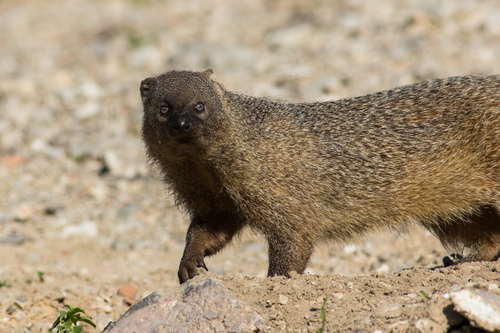
Egyptian Mongoose
Herpestes ichneumon
A legendary hunter of the Nile, the Egyptian Mongoose is a master of the daytime shadows. Known for its snake-fighting prowess and unique family 'caravans,' this sleek predator is a captivating sight for backyard observers.
Quick Identification
Size
Body length 48–60 cm (19–24 in) with a 33–54 cm (13–21 in) tail; weighs 1.7–4 kg (3.7–8.8 lb)
Colors
Grizzled grey-brown coat with a salt-and-pepper appearance; black-tipped tail; reddish-brown eyes
Key Features
- Coarse, grizzled grey fur with long guard hairs
- Bushy tail ending in a distinct black tuft
- Slender, elongated body with very short legs
- Diurnal activity—most active during daylight
When You’ll See Them
Geographic range
Where Does the Egyptian Mongoose Live?
The Egyptian Mongoose is a wide-ranging species native to the African continent, where it can be found everywhere from the Nile Valley to the Cape of Good Hope, avoiding only the driest deserts and densest rainforests. Beyond Africa, its range extends into the Middle East and the Mediterranean Basin, with a significant and well-established population in the Iberian Peninsula (Spain and Portugal). Scientists continue to debate whether the European populations are naturally native or were introduced by humans in antiquity to control pests.
Basemap © OpenStreetMap contributors
Behavior
The Egyptian Mongoose is a highly intelligent and adaptable predator, notable for being primarily diurnal (active during the day). Unlike many other mongoose species, they are often social, frequently seen traveling in small family groups. One of their most fascinating behaviors is 'caravanning,' where the mother leads her young in a tight single-file line, so close together that the group can be mistaken for a large snake or a single long-bodied animal from a distance.
In their interactions with humans, they are generally shy and will bolt for cover at the first sign of danger. However, they have lived alongside agricultural communities for millennia, prized for their ability to hunt venomous snakes and rodents. They are highly vocal and use a variety of chips and barks to communicate with family members while foraging through thick undergrowth.
EverydayEarth exclusive
Camera Tips
Capturing an Egyptian Mongoose on camera is a rewarding challenge because of their daytime habits. Since they are diurnal, you don't need a heavy-duty infrared flash; instead, focus on high-speed triggers to catch them as they dart between cover. Place your camera along 'edge habitats,' such as the border where a garden meets a wooded area or along the banks of a stream. They are creatures of habit and will often use the same game trails daily to reach water or hunting grounds.
Set your camera low to the ground—about 10 to 15 inches high—to get an eye-level perspective of their low-slung profile. If you are using a trail camera with video capability, set the trigger interval to the shortest possible time. Because they often travel in 'caravans,' the first mongoose might trigger the camera, and you want to ensure you catch the family members following behind in that iconic single-file line.
While we don't recommend feeding wildlife, you can attract them to a specific spot by using scent lures. A small amount of fish-based oil or even a pile of large stones that attracts lizards and rodents will naturally draw a mongoose into your camera's field of view. Be mindful of the sun; since they are active during the day, try to position the camera facing North or South to avoid lens flare during the morning and afternoon peaks when they are most active.
Frequently Asked Questions
Record Egyptian Mongoose at your habitat
Connect a camera to start building your own species record — AI identifies every visitor automatically.