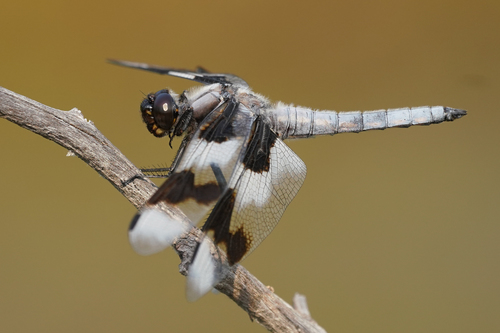
Eight-spotted Skimmer
Libellula forensis
A striking master of the western wetlands, the Eight-spotted Skimmer is famous for its bold wing patterns and territorial spirit. These agile flyers are a backyard favorite for anyone with a pond or water feature.
Quick Identification
Size
45-55 mm (1.8-2.2 in) in length; wingspan of 80-90 mm (3.1-3.5 in)
Colors
Brown body with yellow-orange side stripes; wings have two black nodes per wing; mature males develop bright white patches between black spots
Key Features
- Two distinct black spots on each wing
- Mature males show bright white wing patches
- Stout brownish abdomen with yellow lateral dashes
- Frequently perches on tips of vegetation
When You’ll See Them
Geographic range
Where Does the Eight-spotted Skimmer Live?
Native to western North America, the Eight-spotted Skimmer is a staple of the landscape from British Columbia and Alberta in Canada down through the western United States to northern Mexico. It is most prevalent in the Pacific Coast states and the Rocky Mountain region, thriving in a variety of environments ranging from sea-level wetlands to high-elevation mountain ponds. While it is a western specialist, it is highly adaptable to human-made habitats like irrigation ditches and suburban garden ponds.
Basemap © OpenStreetMap contributors
Behavior
The Eight-spotted Skimmer is a classic 'percher,' a dragonfly that spends the majority of its day stationed on a prominent twig or reed. From these vantage points, they scan the sky for both prey and rival males. They are fiercely territorial; a resident male will launch aggressive aerial sorties to drive away intruders, often returning to the exact same perch once the coast is clear. This predictable behavior makes them one of the easier dragonflies to observe and photograph in a backyard setting.
In the heat of the afternoon, you may witness a unique thermoregulation behavior called 'obelisking.' The skimmer will raise its abdomen vertically toward the sun, minimizing the surface area exposed to direct heat to keep its body temperature stable. While they are high-energy hunters, they are relatively approachable by humans if moved toward slowly, allowing for a close-up look at their intricate wing venation and large, multi-faceted compound eyes.
EverydayEarth exclusive
Camera Tips
To capture the Eight-spotted Skimmer on camera, you must think like a percher. These dragonflies have favorite 'stations'—usually the highest tip of a reed, a garden stake, or a dead branch near water. Position your camera on a tripod or mount, focusing specifically on the very tip of a likely perch. Because dragonflies are small, a macro lens or a telephoto lens with a short minimum focus distance is ideal for capturing the 'eight' wing spots in detail.
Dragonflies are most active when the sun is high and the air is warm. For the best results, set your camera to trigger during the peak heat of the day, between 11 AM and 3 PM. Use a high shutter speed—ideally 1/1000s or faster—to freeze the motion of their wings, which move too fast for the human eye to track. If your camera supports AI-subject detection, ensure it is set to 'Insects' to help lock focus on the head and thorax rather than the wings.
You can effectively 'lure' this species by creating a landing zone. Place a few bamboo stakes or tall, sturdy sticks at 45-degree angles around the edge of a pond or birdbath. If you notice a skimmer already using a specific twig, move your camera into position nearby; they are creatures of habit and will almost certainly return to that exact spot after hunting. Avoid placing the camera where it will cast a shadow over the perch, as this may discourage them from landing.
Similar Species
Species that look similar or are commonly confused with Eight-spotted Skimmer.
Frequently Asked Questions
Record Eight-spotted Skimmer at your habitat
Connect a camera to start building your own species record — AI identifies every visitor automatically.