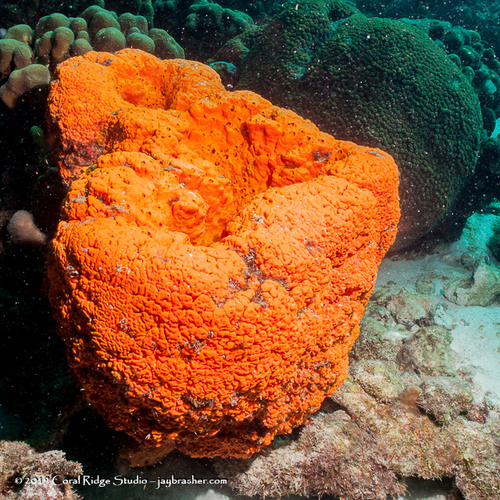
Elephant Ear Sponge
Agelas clathrodes
A vibrant architectural masterpiece of the Caribbean reefs, the Elephant Ear Sponge is a massive filter feeder that provides a home for hundreds of smaller sea creatures.
Quick Identification
Size
Width typically ranges from 30 to 100 cm (12-40 inches), though exceptionally large specimens can reach up to 2 meters (6.5 feet) in diameter.
Colors
Brilliant reddish-orange to bright orange exterior; the interior tissue is a slightly paler, creamy orange.
Key Features
- Massive, ear-like or fan-shaped growth forms
- Bright reddish-orange coloration that stands out on reefs
- Numerous large, visible pores (oscula) on the surface
- Leathery, slightly compressible texture similar to a heavy sponge or cork
When You’ll See Them
Geographic range
Where Does the Elephant Ear Sponge Live?
The Elephant Ear Sponge is a quintessential resident of the warm tropical waters of the Western Atlantic and the Caribbean Basin. Its range is centered primarily within the Caribbean Sea, where it thrives on deep reef slopes and coral walls sheltered from heavy wave action. You can find robust populations stretching from the waters of Southern Florida and the Bahamas down through the Greater and Lesser Antilles, and along the coastal reefs of Central and South America. It is a signature species in high-biodiversity marine parks like those found in Bonaire, the Cayman Islands, and the Mesoamerican Barrier Reef.
Basemap © OpenStreetMap contributors
Behavior
While it lacks a nervous system or muscles, the sponge can react very slowly to physical stimuli or changes in water quality by constricting its pores. It is a slow-growing species, often taking decades to reach its full, impressive size. Because it is stationary, it relies on its chemical defenses—producing unique secondary metabolites—to deter predators like fish and sea turtles from grazing on its tissue.
In the social structure of the reef, this sponge acts as a 'metropolis' for smaller creatures. Brittle stars, small crabs, shrimp, and gobies are frequently found living within its folds or deep inside its internal canal system. This symbiotic relationship provides protection for the smaller animals while the sponge remains largely unaffected by its tiny tenants.
EverydayEarth exclusive
Camera Tips
Capturing the Elephant Ear Sponge requires specialized underwater equipment, as this species lives well below the reach of surface light. For the best results, use a high-quality action camera or a mirrorless camera in a waterproof housing. Because water absorbs red light first, these sponges will appear dull or brownish at depth without help. Use a red filter or powerful external 'video lights' (LEDs with a high Color Rendering Index) to reveal their true, spectacular orange hue.
When positioning your camera, look for a 'hero' specimen on a reef wall or ledge. Use a weighted tripod or a flexible arm mount to stabilize the camera against the seafloor, being careful not to touch or damage any living coral or the sponge itself. A wide-angle lens is essential to capture the massive, ear-like scale of the organism against the vast blue background of the ocean.
Time-lapse photography is a fantastic way to document this species. While the sponge doesn't move, a time-lapse will capture the constant 'traffic' of reef life—fish darting in and out of the sponge's shadows and invertebrates crawling across its surface. Set your camera to take a photo every 5-10 seconds over a period of an hour to see the reef come to life around this orange giant.
Similar Species
Species that look similar or are commonly confused with Elephant Ear Sponge.
Frequently Asked Questions
Record Elephant Ear Sponge at your habitat
Connect a camera to start building your own species record — AI identifies every visitor automatically.