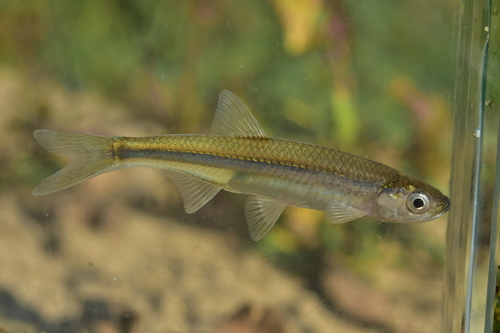
Emerald Shiner
Notropis atherinoides
The Emerald Shiner is a shimmering jewel of North American waterways, known for its iridescent green stripe and massive, synchronized schools.
Quick Identification
Size
5-10 cm (2-4 inches) in length; weighs less than 10 grams (0.35 oz)
Colors
Translucent silvery body with a brilliant iridescent emerald-green or blue-silver stripe along the sides; white silvery belly; clear fins.
Key Features
- Slender, elongated and compressed body shape
- Large, prominent eyes and a blunt, rounded snout
- Distinctive shimmering emerald lateral band
- Dorsal fin starts directly above or slightly behind the pelvic fins
When You’ll See Them
Geographic range
Where Does the Emerald Shiner Live?
Where Does the Emerald Shiner Live? This resilient minnow is a quintessential North American species, boasting a massive native range that spans the heart of the continent. From the chilly waters of the Hudson Bay drainage in Canada, their territory flows southward through the Great Lakes and the entire Mississippi River basin, reaching all the way to the Gulf of Mexico. While they thrive in the vast expanses of large lakes and deep rivers, they are also frequently found in connected suburban waterways and reservoirs across the eastern and central United States.
Basemap © OpenStreetMap contributors
Behavior
Emerald Shiners are highly social, schooling fish that spend much of their lives in large, coordinated groups. These schools are often found near the surface of open waters, where they create a shimmering effect that can be visible even from above the waterline. They are known for their impressive vertical migrations, moving from deeper water during the day to the surface at night to feed on plankton.
Because they are a primary forage fish, their behavior is often dictated by predator avoidance. They are fast, agile swimmers but are frequently pursued by larger game fish like Walleye and Bass. In human-populated areas, they are often seen congregating around docks and piers, particularly at night when they are drawn to artificial light sources.
EverydayEarth exclusive
Camera Tips
To capture high-quality footage of Emerald Shiners, you will need a waterproof action camera or a specialized underwater trail camera. Because these fish are attracted to light (phototactic), the best strategy is to mount your camera to a dock piling or a weighted tripod near a pier that has overhead lighting. If no lighting is available, using a camera with a low-intensity underwater LED will draw schools directly into the frame at night.
Set your camera to a high frame rate (at least 60fps). Emerald Shiners are incredibly fast and can dart in and out of the field of view in a fraction of a second; higher frame rates allow you to slow down the footage to see their shimmering scales clearly. Position the lens 1-2 feet below the surface, angled slightly upward to capture the reflection of the silver fish against the surface of the water.
For the best results in a backyard pond or lakefront, place the camera near structure like submerged logs or aquatic vegetation. While they are open-water fish, they often hover near the edges of cover to hide from predators. If using AI-triggering, ensure the sensitivity is high, as their translucent bodies can sometimes blend into the background of murky water.
Similar Species
Species that look similar or are commonly confused with Emerald Shiner.
Frequently Asked Questions
Record Emerald Shiner at your habitat
Connect a camera to start building your own species record — AI identifies every visitor automatically.