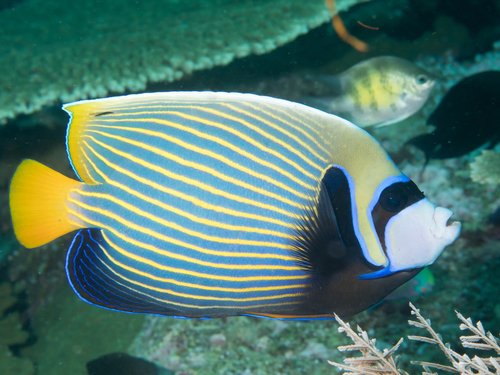
Emperor Angelfish
Pomacanthus imperator
With its mesmerizing neon stripes and iconic bandit mask, the Emperor Angelfish is the undisputed royalty of the coral reef. Witness one of nature's most dramatic transformations as they shift from circular juvenile patterns to their majestic adult colors.
Quick Identification
Size
Adults reach 30 to 40 cm (12 to 15.7 inches) in length; they typically weigh between 0.5 to 1 kg (1.1 to 2.2 lbs).
Colors
Adults feature striking horizontal stripes of electric blue and bright yellow. A distinct black mask covers the eyes, and the tail is a vibrant orange-yellow. Juveniles are radically different, displaying concentric circles of white and neon blue on a dark navy background.
Key Features
- Bold horizontal yellow and blue stripes on the body
- Distinctive black bandit mask over the eyes
- Vibrant orange-yellow caudal fin
- Juveniles have circular white and blue patterns on a dark base
When You’ll See Them
Geographic range
Where Does the Emperor Angelfish Live?
This stunning species is native to the vast Indo-Pacific region, spanning from the warm waters of the Red Sea and East Africa across to the Hawaiian Islands and the Tuamotus. It is commonly found throughout the Great Barrier Reef in Australia, the Coral Triangle of Southeast Asia, and as far north as southern Japan. While they are occasionally spotted in the eastern Pacific, their heartland remains the biodiversity hotspots of the central and western Pacific and Indian Oceans.
Basemap © OpenStreetMap contributors
Behavior
The Emperor Angelfish is a quintessential reef resident, often found patrolling coral-rich areas in search of its next meal. While adults are generally solitary or found in monogamous pairs, they are highly territorial and will defend their home range against other angelfish using a surprisingly loud clicking or 'thumping' sound when agitated. This acoustic behavior is one of the more unique aspects of their social interaction, serving as a warning to intruders.
In their juvenile stage, these fish exhibit a fascinating behavior as cleaner fish. They set up cleaning stations where larger fish visit to have parasites removed from their skin and gills. As they mature, their diet and social standing shift. Despite their territorial nature toward their own kind, they are generally curious and bold around divers and underwater cameras, making them a favorite subject for reef monitoring projects.
EverydayEarth exclusive
Camera Tips
Capturing the Emperor Angelfish requires an underwater camera setup, such as an AI-powered reef cam or a waterproof action camera mounted to a fixed substrate. For the best results, position your camera near large, healthy sponge formations or coral overhangs where these fish naturally forage. Angelfish are creatures of habit and often follow the same patrol routes daily; if you spot one on your feed, there is a high likelihood it will return to that exact spot within a few hours.
Because these fish are most active during the day, ensure your camera is positioned to take advantage of natural light. Ideally, mount the camera at a slight upward angle (about 15 degrees) to capture the thicker part of the water column and catch the shimmer of their blue and yellow stripes as they swim by. If the camera is placed too deep, you may lose the vibrancy of their yellow stripes, so try to keep setups within the top 10-15 meters where sunlight penetration is strongest.
Settings-wise, use a high frame rate (at least 60fps) to capture their fluid movements without blur, as they can be surprisingly quick when darting between reef sections. If your camera supports color correction, enable 'underwater mode' or use a red filter to ensure the colors aren't washed out by the blue-green spectrum of the water. Early morning and late afternoon provide the most dramatic lighting for their iridescent scales, often creating a glowing effect on their neon-blue borders.
Similar Species
Species that look similar or are commonly confused with Emperor Angelfish.
Semicircle Angelfish
Similar juvenile patterns, but adults lack the horizontal stripes and have a more drab, greenish-brown speckled appearance with blue edges.
Blueface Angelfish
Features a bright blue reticulated face and a yellow dorsal fin, lacking the full-body horizontal yellow and blue striping of the Emperor.
Frequently Asked Questions
Record Emperor Angelfish at your habitat
Connect a camera to start building your own species record — AI identifies every visitor automatically.