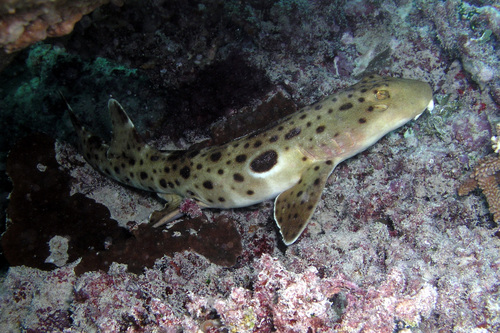
Epaulette Shark
Hemiscyllium ocellatum
Famed for its ability to 'walk' on land and survive in oxygen-starved pools, the epaulette shark is a master of the tropical reef flats.
Quick Identification
Size
70–90 cm (27–35 in) on average, reaching up to 107 cm (42 in); weighs approximately 1–2 kg (2–4 lbs).
Colors
Tan to light brown body with numerous small dark spots; features a prominent large black spot ringed in white behind each pectoral fin.
Key Features
- Large black 'epaulette' spot behind pectoral fins
- Slender, elongated body with a tail comprising over half its length
- Muscular, paddle-shaped fins used for 'walking' along the seabed
- Small mouth and nasal barbels located well forward on the snout
When You’ll See Them
Geographic range
Where Does the Epaulette Shark Live?
The epaulette shark is a classic inhabitant of the Indo-Pacific, centered primarily around the northern half of Australia and the island of New Guinea. Its native territory stretches from the world-famous Great Barrier Reef in Queensland, across the Torres Strait, and into the lush marine habitats of Papua New Guinea and Western New Guinea, Indonesia. Within this region, they are highly localized to shallow reef environments and are rarely found far from the protective cover of the coast.
Basemap © OpenStreetMap contributors
Behavior
Primarily nocturnal, these sharks spend the daylight hours hidden away in the safety of coral crevices or beneath table corals to avoid larger predators. At night, they emerge to forage in the shallows, often in water just a few inches deep. Despite their shark lineage, they are entirely harmless to humans and tend to be quite docile, though they will swim away quickly if they feel threatened by a sudden movement or bright light.
EverydayEarth exclusive
Camera Tips
To capture the epaulette shark on camera, you need a setup capable of handling very shallow marine environments. Since these sharks are most active during the night in tide pools, an underwater housing with a wide-angle lens is your best bet. Position the camera on a weighted tripod or a flat rock at the edge of a reef pool as the tide begins to recede. The goal is to catch the shark as it begins its nightly foraging or as it 'walks' between pools. Angle the camera horizontally to emphasize their unique gait and long, slender tail.
Lighting is the most critical factor for night-time reef photography. Use low-glow infrared (IR) lights or red-filtered LEDs to illuminate the area without startling the shark or washing out the image. Place your lights at an angle to the lens rather than directly behind it; this reduces 'backscatter' from suspended particles in the water and brings out the beautiful spotted pattern of the shark's skin. Avoid high-intensity white strobes, which can cause the shark to seek cover immediately.
While epaulette sharks are curious, they are also cautious. A light application of scent-based attractant—such as a small mesh bag of crushed crabs or shrimp secured near the focal point—can keep the shark in the frame long enough for a high-quality capture. Set your camera to a high-frame-rate video mode rather than still photos. The true magic of this species lies in its movement; seeing the way it alternates its fins to walk across the sand is far more impressive than a static image.
Always check local tide charts before deployment. The best action occurs during the 'king' low tides when the reef flats are exposed. Ensure your equipment is properly tethered to prevent it from being swept away by the incoming tide, and always rinse your camera housing with fresh water after each deployment to prevent salt corrosion.
Frequently Asked Questions
Record Epaulette Shark at your habitat
Connect a camera to start building your own species record — AI identifies every visitor automatically.