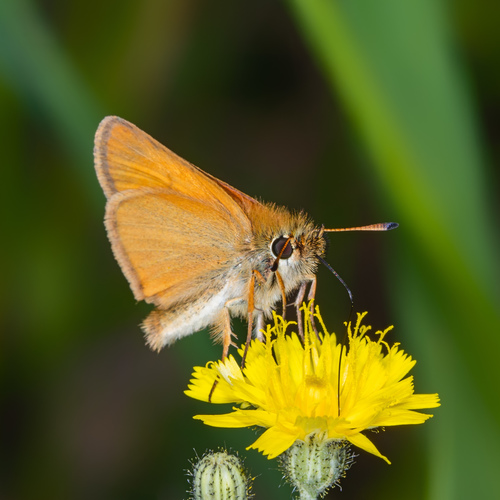
Essex Skipper
Thymelicus lineola
A shimmering golden dart of the summer meadow, the Essex Skipper is a master of the 'quick-skip' flight. Often hiding in plain sight, this tiny butterfly is a delight for patient backyard observers.
Quick Identification
Size
Wingspan of 25–30 mm (1.0–1.2 inches); length approximately 13–15 mm (0.5 inches)
Colors
Bright golden-orange or tawny wings with narrow dark borders; underside of antennae tips are distinctively black
Key Features
- Black-tipped undersides of antennae
- Golden-orange wings with dark veins near margins
- Male has a short, thin black scent line (sex brand) on the forewing
- Resting posture with forewings held at an angle and hindwings flat
When You’ll See Them
Geographic range
Where Does the Essex Skipper Live?
The Essex Skipper is native to the temperate regions of Europe, North Africa, and Central Asia, stretching from the United Kingdom across to the Amur region. It has also become a highly successful introduced species in North America, where it is known as the European Skipper. Since its accidental introduction to Ontario in the early 20th century, it has spread across much of the northeastern United States and southern Canada, often becoming the most numerous butterfly in its local range.
Basemap © OpenStreetMap contributors
Behavior
The Essex Skipper is a frantic and energetic flyer, often seen darting between tall grasses with a characteristic 'skipping' motion that gives the family its name. Unlike many larger butterflies that glide, this species moves in short, rapid bursts. During the heat of the day, they are most active, seeking out nectar-rich flowers or patrolling their small territories to find mates. They are famously sun-lovers and will frequently be seen basking on leaves with their wings held in a unique 'jet plane' configuration.
While they are solitary foragers, they can appear in high densities in favorable habitats like hay meadows or overgrown garden corners. They are not particularly shy of humans but their small size and speed make them difficult to observe closely without a camera. At night or during cloudy weather, they rest deep within tall grass stems, hanging head-downwards to stay camouflaged from predators like spiders and birds.
EverydayEarth exclusive
Camera Tips
Capturing the Essex Skipper on a backyard AI camera requires a focus on 'botanical hotspots.' Because these butterflies are small and move quickly, you should position your camera no more than 12 to 18 inches away from nectar-rich flowers like Lavender, Buddleia, or Thistles. A low-angle shot looking slightly upward can capture the golden glow of their wings against the sky, which helps the AI identification software pick up the wing vein patterns and the crucial antennae tips.
Lighting is your best friend with this species. Place your camera in a south-facing spot that receives full sun between 10 AM and 2 PM. These butterflies are 'thermal specialists' and will spend significant time basking in these bright areas to warm up their flight muscles. If your camera has a macro or close-focus mode, ensure it is activated, as the fine details of the black-tipped antennae are the only way to distinguish them from the nearly identical Small Skipper.
To increase your capture rate, consider leaving a patch of your lawn to grow long, especially if it contains Timothy-grass or Cocks-foot grass. This provides a breeding ground and a resting place. Since these insects are light, they are easily tossed by the wind; setting up your camera in a 'wind-break' area near a fence or hedge will yield much steadier footage and more frequent visits. Set your camera to a high-speed burst mode or high-frame-rate video to catch their rapid take-offs and landings.
Similar Species
Species that look similar or are commonly confused with Essex Skipper.
Small Skipper
Virtually identical, but the Small Skipper has orange-brown undersides to its antennae tips, whereas the Essex Skipper's are black.
Lulworth Skipper
Smaller and darker with a more olive-green tint to the wings and a distinct circle of pale spots on the forewings.
Silver-spotted Skipper
Much larger and features bright white/silver spots on the underside of the hindwings which the Essex Skipper lacks.
Frequently Asked Questions
Record Essex Skipper at your habitat
Connect a camera to start building your own species record — AI identifies every visitor automatically.