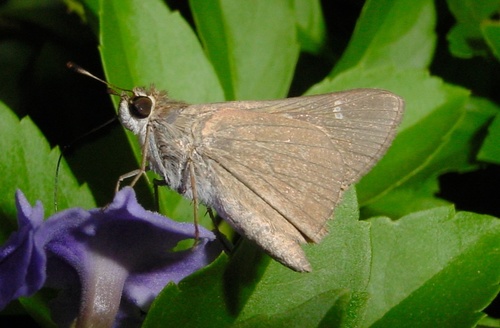
Eufala Skipper
Lerodea eufala
The Eufala Skipper is a master of camouflage and a marathon traveler. Though it blends seamlessly into the grasses of a typical backyard, this tiny butterfly migrates thousands of miles across the Americas every year.
Quick Identification
Size
Wingspan of 2.5 to 3.2 cm (1.0 to 1.25 inches)
Colors
Upperside is a uniform brownish-gray with three small, translucent white spots on the forewing; underside is pale olive-gray to tan.
Key Features
- Drab brownish-gray coloring with minimal markings
- Three to four tiny translucent white spots in a row on the forewing
- Characteristic 'skipper' profile with a thick, moth-like body and large head
- Underside of hindwing is nearly uniform olive-gray without distinct spots.
When You’ll See Them
Geographic range
Where Does the Eufala Skipper Live?
Native to the Americas, the Eufala Skipper maintains a permanent presence from the southern United States through Mexico and Central America, reaching as far south as Patagonia in South America. In the United States, it is a year-round resident in the Deep South and Southwest, but it is a prolific seasonal migrant. During the summer months, it pushes northward into the Midwest and even parts of southern Canada, though these northern populations cannot survive the winter frost and must recolonize annually.
Basemap © OpenStreetMap contributors
Behavior
The Eufala Skipper is a high-energy butterfly known for its rapid, darting flight pattern. Like most skippers, it moves so quickly that it can be difficult to track with the naked eye, often appearing as a small gray blur as it 'skips' from one flower to the next. When it rests, it frequently adopts a 'jet-plane' posture, holding its forewings at a 45-degree angle while keeping its hindwings flat, a posture unique to the skipper family.
This species is highly adaptable and comfortable around human habitation. It is a common sight in suburban lawns where it searches for nectar or places to lay eggs on various grasses. While not as flashy as a Monarch or Swallowtail, the Eufala Skipper is a resilient survivor, capable of breeding in diverse environments ranging from manicured gardens to industrial roadsides.
EverydayEarth exclusive
Camera Tips
Capturing a Eufala Skipper on camera requires a strategy focused on low-profile nectar sources. These butterflies rarely visit tall flowering bushes; instead, they prefer 'weedy' flowers in the lawn or low-growing garden plants like lantana, zinnia, and clover. Set your camera on a ground stake or a small tripod, aiming the lens at a sunny patch of flowers no higher than 12 inches off the ground. Because of their small size, you will need to place the camera within 2 to 3 feet of the target area to get enough detail for identification.
Lighting is crucial for this species. Their olive-gray coloring is subtle and can easily wash out in low light or look like a common moth. Positioning your camera so the sun is behind it will highlight the tiny translucent spots on their wings, which are a key field mark. Since these insects are incredibly fast, use your camera’s highest frame rate for video or a 'Burst' photo mode. If your camera allows for manual focus, pre-focusing on a specific flower head can prevent the lens from 'hunting' when the butterfly suddenly appears.
Standard trail cameras with PIR sensors often struggle to detect the movement of small insects. To overcome this, use a 'Time Lapse' mode set to trigger every 15 to 30 seconds during the peak heat of the day (roughly 11 AM to 3 PM). This is when the Eufala Skipper is most active and likely to be found foraging. To attract them specifically to your camera's field of view, avoid mowing a small patch of your lawn that contains clover or dandelions, as these are natural magnets for this species.
Similar Species
Species that look similar or are commonly confused with Eufala Skipper.
Frequently Asked Questions
Record Eufala Skipper at your habitat
Connect a camera to start building your own species record — AI identifies every visitor automatically.