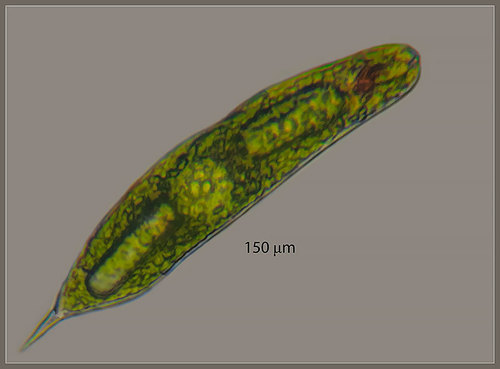
Euglena oxyuris
Lepocinclis oxyuris
A giant of the microscopic world, Euglena oxyuris is a stunning green flagellate that bridges the gap between plant and animal life in your backyard pond.
Quick Identification
Size
150–500 micrometres (0.006–0.02 inches) in length; microscopic but one of the largest in its genus
Colors
Bright grass-green due to chloroplasts; features a prominent reddish-orange eyespot (stigma)
Key Features
- Elongated spindle-shaped body with a pointed tail
- Rigid, slightly twisted pellicle (outer shell) with fine longitudinal stripes
- Large, clear nucleus typically positioned in the center
- Prominent red eyespot used for light sensing
When You’ll See Them
Geographic range
Where Does the Euglena oxyuris Live?
Found in freshwater ecosystems across nearly every continent, Euglena oxyuris is a truly cosmopolitan micro-organism. It is native to the temperate and tropical regions of North America, Europe, and Asia, thriving in any permanent or semi-permanent body of water that receives adequate sunlight. Because it is easily transported by wind, water birds, or human activity, it has established stable populations in almost every country where suitable freshwater habitats exist.
Basemap © OpenStreetMap contributors
Behavior
Euglena oxyuris is a fascinating single-celled organism that exhibits a blend of plant and animal behaviors. Unlike many of its smaller relatives, this species has a relatively rigid body structure, meaning it doesn't change shape (metaboly) as drastically as other Euglena. It moves through the water using a single, whip-like flagellum, often spinning slowly on its axis as it glides. This movement is highly purposeful, as the organism uses its light-sensitive eyespot to perform phototaxis—navigating toward light sources to maximize its photosynthetic potential.
While it often lives a solitary life, Euglena oxyuris can be found in high concentrations in environments rich in organic matter. It is a sensitive indicator of water quality, often appearing in higher numbers in stagnant or slow-moving water where decomposition is occurring. It interacts with its environment by acting as both a producer, generating oxygen, and a consumer, helping to regulate bacterial populations in the micro-ecosystem of a backyard pond.
EverydayEarth exclusive
Camera Tips
To capture Euglena oxyuris with an AI-powered camera, you will need a specialized digital microscope setup or an underwater macro lens designed for pond life. Since these organisms are microscopic, your camera must be focused on a very thin plane of water. The best way to find them is to take a sample of pond water from the 'benthic zone'—the area just above the mud or silt at the bottom—where they congregate to feed on organic debris. Placing a small amount of this water on a glass slide or in a micro-aquarium will give your AI the best chance of identification.
Lighting is the most critical factor for a clear capture. Use 'transmitted light' (shining light from behind the organism) to highlight the internal chloroplasts and the nucleus. If your camera setup allows for 'dark-field' illumination, the Euglena will appear to glow against a black background, which makes the fine details of its twisted pellicle and its bright red eyespot stand out vividly for the AI's detection algorithms.
For continuous backyard monitoring, place a submerged sensor near the stems of aquatic plants like water lilies or hornwort. These plants provide the perfect micro-environment for Euglena blooms. Because these organisms are most active and congregate near the surface for photosynthesis during the middle of the day, ensure your camera is positioned to receive bright, indirect sunlight, or use a consistent LED light source to maintain a high frame rate for tracking their flagellar movement.
Similar Species
Species that look similar or are commonly confused with Euglena oxyuris.
Euglena gracilis
Much smaller and highly flexible, constantly changing shape (metaboly), whereas E. oxyuris is more rigid.
Phacus longicauda
Has a much flatter, leaf-like body shape with a distinctively long, thin tail spine.
Lepocinclis spirogyroides
Features more prominent spiral rows of 'warts' or granules on its pellicle and is typically shorter.
Frequently Asked Questions
Record Euglena oxyuris at your habitat
Connect a camera to start building your own species record — AI identifies every visitor automatically.