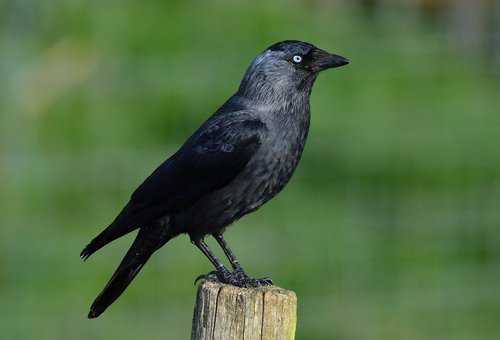
Eurasian Jackdaw
Coloeus monedula
The Eurasian Jackdaw is the dapper, silver-eyed intellectual of the corvid family. Known for their complex social lives and cheeky personalities, these clever birds are a joy to observe on backyard cameras.
Quick Identification
Size
Length 34–39 cm (13–15 in); Wingspan 67–74 cm (26–29 in); Weight 220–270 g (7.8–9.5 oz)
Colors
Charcoal black body plumage with a distinctive silvery-grey nape and ear coverts; piercing pale grey or white irises
Key Features
- Distinctive silvery-grey hood and neck
- Piercing white or pale grey irises
- Compact, stocky build with a short, stout bill
- Energetic, jerky 'swaggering' walk
When You’ll See Them
Geographic range
Where Does the Eurasian Jackdaw Live?
The Eurasian Jackdaw is native to a vast region stretching from the British Isles and Western Europe across to Central Asia and the Himalayas. To the south, their range extends into North Africa and the Mediterranean basin. While most populations in Western and Southern Europe are year-round residents, those breeding in the colder climates of Scandinavia and Northern Russia are partial migrants that move south or west during the winter months to avoid heavy snow cover.
Basemap © OpenStreetMap contributors
Behavior
Eurasian Jackdaws are remarkably social and intelligent birds, known for forming lifelong monogamous pair bonds. They are often seen moving in pairs even within large flocks, frequently engaging in 'allopreening' where they groom each other’s head feathers to reinforce their bond. They possess a complex social hierarchy and are capable of recognizing individual human faces, a testament to their advanced corvid intelligence.
In the backyard, Jackdaws are bold and inquisitive. Unlike their more cautious larger cousins like the Carrion Crow, Jackdaws often become quite tame around humans if not persecuted. They are cavity nesters by nature, famously utilizing chimney pots, hollow trees, and crevices in old buildings. Their vocalizations are varied, ranging from the classic metallic 'chak-chak' call to more complex social signals used during their spectacular communal roosting displays.
EverydayEarth exclusive
Camera Tips
To capture high-quality footage of Eurasian Jackdaws, focus your camera on flat, elevated surfaces. While they do forage on the ground, they feel most secure on garden tables, flat-topped walls, or sturdy bird feeding platforms. Positioning your camera 3 to 5 feet high with a slightly downward angle will allow you to see the beautiful contrast of their silvery napes against their dark bodies when they tilt their heads to feed.
These birds are highly motivated by high-protein lures. Suet pellets, mealworms, and even high-quality soaked dog kibble are excellent attractants. Because Jackdaws almost always travel in pairs or small family groups, use a wide-angle setting rather than a tight zoom. This allows you to witness their fascinating social interactions, such as pair-bonding displays or the subordinate birds giving way to dominant ones.
Jackdaws are very active in the early morning, so ensure your camera is set to record at first light. The low-angle morning sun is particularly effective at catching the glint in their pale white eyes, which is their most striking feature. During the spring (March–May), you can capture unique behavior by placing your camera near a source of nesting material, such as bundles of sheep's wool or dry twigs, as they are tireless architects during this period.
In hot weather, a shallow but wide bird bath is a magnet for this species. Jackdaws are vigorous bathers and often visit in groups for a communal wash. Set your camera’s trigger speed to the fastest possible setting (0.2–0.5 seconds) to capture the rapid wing beats and water splashes. Avoid placing the camera too close to the water to prevent lens blurring from the spray.
Similar Species
Species that look similar or are commonly confused with Eurasian Jackdaw.
Carrion Crow
Much larger than a Jackdaw with an all-black plumage and dark eyes, lacking the grey nape.
Rook
Identified by a bare, greyish-white patch of skin at the base of the bill and a more peaked head shape.
Daurian Jackdaw
Found further east in Asia; adults have a distinct white collar and underparts.
Frequently Asked Questions
Record Eurasian Jackdaw at your habitat
Connect a camera to start building your own species record — AI identifies every visitor automatically.