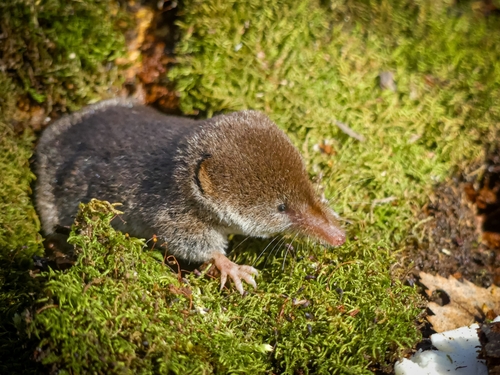
Eurasian Pygmy Shrew
Sorex minutus
A pint-sized powerhouse of the undergrowth, the Eurasian Pygmy Shrew is one of the world's smallest mammals. With a heart that beats 1,000 times a minute, this tiny predator is a marvel of high-speed evolution.
Quick Identification
Size
Body length: 40–60 mm (1.6–2.4 in); Tail: 32–46 mm (1.3–1.8 in); Weight: 2.4–6.1 g (0.08–0.22 oz)
Colors
Uniformly brownish-grey or bronze on the back with a distinct transition to a pale silvery-grey or white belly.
Key Features
- Miniscule size, often weighing less than a standard credit card
- Proportionately long and noticeably hairy tail compared to other shrews
- Extremely pointed, mobile snout with sensitive whiskers
- Red-tipped teeth caused by iron deposits in the enamel
When You’ll See Them
Geographic range
Where Does the Eurasian Pygmy Shrew Live?
The Eurasian Pygmy Shrew is native to the vast northern Palearctic region, stretching from the Atlantic coast of Ireland and the United Kingdom across the entirety of Europe and through Northern Asia to the Altai Mountains and Siberia. In many parts of its range, including the British Isles, it is one of the most common small mammals, though its secretive nature makes it difficult to spot. It is notably the only shrew species native to Ireland, where it thrives in the absence of larger shrew competitors.
Basemap © OpenStreetMap contributors
Behavior
The Eurasian Pygmy Shrew is a creature of perpetual motion, driven by a metabolic rate so high that it must consume its own body weight in food every single day. Because it burns energy so quickly, it lives on a frantic schedule of waking and sleeping, feeding every two to three hours throughout the day and night. It does not hibernate, meaning it must maintain this exhausting pace even in the depths of winter, often foraging beneath the snow or in deep leaf litter.
Unlike their larger cousins, Pygmy Shrews are not particularly skilled at digging their own tunnels. Instead, they navigate the world through the 'leaf litter zone,' using the existing burrows of mice or voles and following natural crevices under logs and stones. They are fiercely solitary and highly territorial; if two individuals meet outside of the breeding season, they will often engage in high-pitched squeaking matches until one retreats.
EverydayEarth exclusive
Camera Tips
Capturing a Eurasian Pygmy Shrew on camera requires a specialized setup because of their tiny size and lightning-fast movements. Most standard trail cameras have a minimum focus distance of about 1 to 2 meters, which is too far for a 5-centimeter mammal. To get clear shots, use a camera with a 'macro' mode or attach a close-up lens (like a +2 diopter) over the camera's existing lens. This allows you to focus on a small patch of ground just 30-50 cm away.
Placement is everything. Don't point your camera at an open lawn; instead, look for 'shrew highways'—the narrow gaps between a log and a wall, or the thick leaf litter beneath a hedgerow. Position the camera just 2 or 3 inches off the ground, angled slightly downward. Because they are so light, they may not trigger some PIR sensors, so set your camera to its highest sensitivity or use a 'Time Lapse' mode that takes a photo every 5-10 seconds if you suspect they are present.
To encourage them to linger in front of the lens, use a scent-based lure rather than large chunks of food. A small amount of mealworms or specialized insectivorous bird food placed inside a small, upturned ceramic pot with a small entrance hole will keep the shrew occupied and in the frame. Avoid using peanut butter or seeds, as these will attract mice and rats which may scare the shrew away or monopolize the feeding site.
Similar Species
Species that look similar or are commonly confused with Eurasian Pygmy Shrew.
Frequently Asked Questions
Record Eurasian Pygmy Shrew at your habitat
Connect a camera to start building your own species record — AI identifies every visitor automatically.