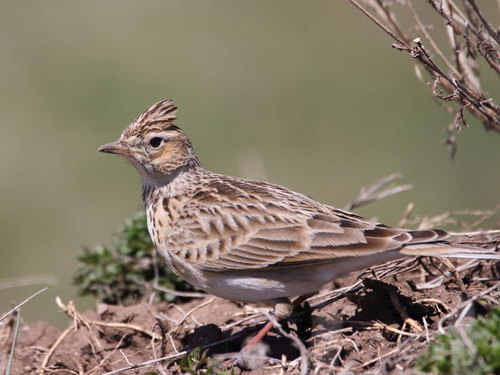
Eurasian Skylark
Alauda arvensis
Famous for its soaring, melodic song and humble brown plumage, the Eurasian Skylark is the quintessential bird of the open countryside. Witness the master of the 'flight song' as it brings life to meadows and farmland across the globe.
Quick Identification
Size
18–19 cm (7–7.5 in) long, 30–36 cm (12–14 in) wingspan, weighing 33–45 g (1.2–1.6 oz)
Colors
Streaked greyish-brown upperparts and breast with a buff-white belly; white outer tail feathers visible in flight. Sexes are identical.
Key Features
- Short, retractable crest on the crown
- White outer tail feathers conspicuous during flight
- Heavily streaked brown plumage with a pale 'eyebrow'
- Long hind claw for walking on soil
When You’ll See Them
Geographic range
Where Does the Eurasian Skylark Live?
Native to the vast Palearctic region, the Eurasian Skylark's range stretches from the United Kingdom and North Africa across Europe and Central Asia to China and Japan. They are widely distributed across the European continent, though they have also been successfully introduced to Australia, New Zealand, and the Hawaiian Islands. While residents in temperate zones, northern populations are migratory and move south to escape harsh winter conditions.
Basemap © OpenStreetMap contributors
Behavior
The Eurasian Skylark is world-renowned for its spectacular aerial displays. During the breeding season, males soar vertically to heights of up to 100 meters, hovering almost out of sight while delivering a complex, liquid song that can last for several minutes. This display is a feat of endurance used to defend large territories and attract mates in wide-open landscapes.
On the ground, skylarks are surprisingly cryptic. They have a distinctive creeping walk rather than a hop, often staying low to the soil to avoid detection by predators. Outside of the breeding season, they become highly social, forming large flocks known as 'exaltations' to forage in stubble fields and saltmarshes. They are strictly ground-nesters, concealing their eggs in shallow hollows lined with grass, hidden among tall crops or meadow vegetation.
EverydayEarth exclusive
Camera Tips
Capturing the Eurasian Skylark on camera requires a specific strategy because they almost never use elevated perches like fences or trees. Instead, position your AI-powered camera as low as possible—ideally 6 to 12 inches off the ground—facing an open patch of short grass or bare earth. If you are in a backyard bordering a field, placing the camera near the boundary where the vegetation changes can be highly effective.
To lure them into the frame, create a 'dust bath' area by clearing a small square of soil and filling it with dry, fine sand; skylarks frequently use these areas to maintain their feathers. During the colder months, scattering fine birdseed, crushed sunflower hearts, or mealworms on the ground in front of the camera can encourage them to linger. Avoid placing the camera near bird tables or tall shrubs, as skylarks feel vulnerable to predators in enclosed spaces.
Focus your monitoring on the early morning hours just after sunrise. This is when males are most likely to be seen performing their vertical takeoff or landing. Ensure your camera's shutter speed is set to a fast mode if possible, as their movements on the ground can be quick and erratic. In winter, look for large 'exaltations' of skylarks that may visit open gardens near coastal or agricultural areas during heavy snow when food is scarce elsewhere.
Similar Species
Species that look similar or are commonly confused with Eurasian Skylark.
Woodlark
Smaller with a noticeably shorter tail and a more prominent white supercilium (eyebrow) that wraps around the back of the head.
Meadow Pipit
Smaller and thinner with a more slender bill; lacks the skylark's crest and has much heavier streaking on its flanks.
Corn Bunting
Larger and chunkier with a very thick, heavy bill and lacks the white outer tail feathers seen in skylarks during flight.
Frequently Asked Questions
Record Eurasian Skylark at your habitat
Connect a camera to start building your own species record — AI identifies every visitor automatically.