Eurasian Sweet-Flag
Acorus calamus
With its sword-like leaves and a scent that bridges the gap between citrus and cinnamon, Eurasian Sweet-Flag is the aromatic star of the wetland. This ancient medicinal plant brings both history and architectural beauty to any pond or marshy edge.
Quick Identification
Size
Grows 60–150 cm (2–5 feet) tall; leaves are 1–2 cm (0.4–0.8 inches) wide
Colors
Bright yellowish-green foliage with a pale green or brownish-yellow flower spike
Key Features
- Sword-shaped leaves with a prominent, off-center midrib
- Characteristic 'crinkled' or wavy edge on one side of the leaf
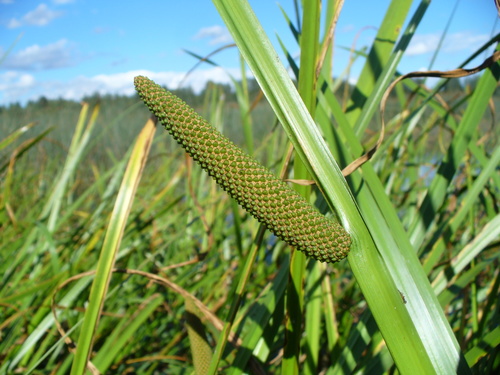
- Spadix (flower spike) emerges at an angle from the side of a leaf-like stalk
- Strong, spicy, citrus-like aroma when any part of the plant is crushed
When You’ll See Them
Geographic range
Where Does the Eurasian Sweet-Flag Live?
Native to the temperate and subtropical regions of South and Central Asia, the Eurasian Sweet-Flag has become a global traveler. Over several centuries, it was introduced to Europe and North America, where it has naturalized extensively in wet, low-lying areas. It is now commonly found across the United Kingdom, much of continental Europe, and throughout the northern and central United States and southern Canada, often thriving where human activity has historically moved medicinal plants.
Basemap © OpenStreetMap contributors
Behavior
Eurasian Sweet-Flag is a hardy, perennial wetland plant that spreads primarily through its thick, creeping rhizomes. Unlike many other flowering plants, it doesn't rely heavily on seeds in many parts of its range; instead, it forms dense, fragrant colonies along the water's edge. It is famously known for its aromatic properties, historically used as a 'strewing herb' on floors to mask odors and as a component in traditional medicines and perfumes.
While it appears stationary, the plant 'behaves' by actively filtering water and providing structural habitat for aquatic life. In the garden or wild backyard setting, it acts as a reliable indicator of saturated soil. It is a slow-growing but persistent species that can dominate a shoreline over several seasons if left unchecked, creating a lush, vertical texture that persists until the first hard frosts of autumn.
EverydayEarth exclusive
Camera Tips
Capturing the Eurasian Sweet-Flag requires a different approach than fast-moving wildlife. Since the plant is stationary, your biggest challenge is movement from the wind. Position your camera on a sturdy, low-profile stake or tripod near the water’s edge. If your camera allows for manual focus or macro settings, aim for the spadix—the unusual finger-like flower spike that juts out from the side of the stalk. This is the plant's most unique photographic feature and distinguishes it from lookalike irises.
Lighting is crucial for bringing out the vibrant yellowish-green of the leaves. Aim for the 'golden hours' of shortly after sunrise or just before sunset. Early morning is particularly effective as you may capture morning dew or mist rising off the water, which adds a dramatic, atmospheric quality to the marshy habitat. Overcast days are also excellent, as they prevent the sun from washing out the subtle textures of the leaf midribs.
Consider using your camera’s time-lapse feature if available. Setting a camera to take one photo every hour during the spring growth spurt (May through June) can create a fascinating record of the leaves shooting upward. Because this plant grows in saturated mud, ensure your camera housing is waterproof and check the mount frequently, as soft soil can shift over time, causing your frame to tilt.
Finally, keep an eye out for 'guests' in your frame. While the plant itself is the subject, Eurasian Sweet-Flag often hosts various dragonflies, damselflies, and small frogs. Setting your camera to a motion-trigger mode can help you capture these small animals using the Sweet-Flag as a hunting perch, providing a complete picture of the backyard wetland ecosystem.
Similar Species
Species that look similar or are commonly confused with Eurasian Sweet-Flag.
Frequently Asked Questions
Record Eurasian Sweet-Flag at your habitat
Connect a camera to start building your own species record — AI identifies every visitor automatically.