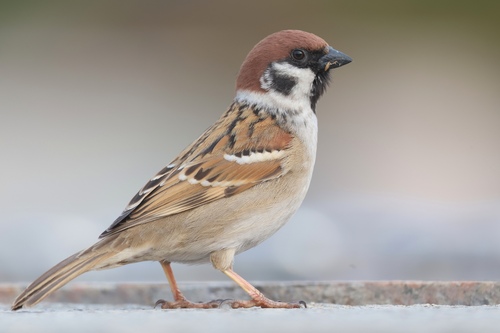
Eurasian Tree Sparrow
Passer montanus
A dapper little visitor with a signature black cheek patch and a rich chestnut crown. The Eurasian Tree Sparrow is a social, high-energy bird that brings life to any backyard feeder or garden hedge.
Quick Identification
Size
Length: 12.5–14 cm (5–5.5 in); Wingspan: 20–22 cm (8–8.7 in); Weight: 18–28 g (0.6–1.0 oz)
Colors
Rich chestnut-brown crown and nape, pure white cheeks with a distinct black patch, small black throat bib, and streaked brown back. Both males and females look identical.
Key Features
- Distinctive black patch on pure white cheeks
- Solid chestnut-brown crown and nape without grey
- Small black bib and white collar around the neck
- Dainty, smaller build compared to the House Sparrow
When You’ll See Them
Geographic range
Where Does the Eurasian Tree Sparrow Live?
The Eurasian Tree Sparrow claims an enormous native range spanning the entire temperate Eurasian continent, from the British Isles across Russia to Japan, and extending south into Southeast Asia. While they are widespread across Europe and Asia, they have also established a unique, localized foothold in North America, specifically around the St. Louis, Missouri region where they were introduced in the late 1870s. These adaptable birds are also common across various island chains in the Pacific, showcasing their ability to thrive in diverse climates from the Siberian steppe to tropical Indonesia.
Basemap © OpenStreetMap contributors
Behavior
The Eurasian Tree Sparrow is a highly social bird that thrives in colonies. Unlike their bolder cousins, the House Sparrows, they are slightly more cautious and prefer the transition zones between woodlands and open fields. They are frequently seen foraging on the ground in small groups, communicating with a series of high-pitched 'chi-chip' calls that are slightly more musical than other sparrow species.
During the breeding season, they are cavity nesters, often taking over old woodpecker holes or competing for nest boxes. While they are common in backyard settings, they generally avoid the dense concrete centers of large European cities, preferring suburban gardens where there is more shrubbery and vegetation. In Southeast Asia, however, they are the primary urban sparrow found in high-density areas, showing remarkable adaptability to human infrastructure.
EverydayEarth exclusive
Camera Tips
To capture the best footage of Eurasian Tree Sparrows, place your camera near a feeding station or a known dust-bathing spot. They are low-level foragers, so mounting your camera on a stake or tripod about 1 to 2 feet (30-60 cm) off the ground, angled slightly upward, will provide a more intimate, eye-level perspective of their social interactions. Ensure the camera is positioned between 3 and 5 feet from the subject to maintain focus, as these are small birds that require a close-up for the black cheek patch to be clearly visible.
Offering a mix of high-quality seeds, particularly millet, sunflower hearts, or cracked corn, will reliably draw them into the frame. During the winter, suet feeders can also be a magnet for these birds. Because they travel in flocks, you are likely to get multiple birds in one shot; setting your camera to a 'Photo + Video' mode or using a high-frame-rate video setting will help you capture their fast-paced movements and social posturing without blur.
Light is crucial for identifying this species accurately. Try to position your camera so the morning sun hits the feeder or birdbath from behind the lens; this illuminates the rich chestnut crown and prevents the white cheek patches from appearing washed out. If you have a nest box installed, placing a camera nearby during the spring can provide fascinating insights into their nesting behavior, but always maintain a respectful distance to avoid disturbing the brood.
Similar Species
Species that look similar or are commonly confused with Eurasian Tree Sparrow.
Frequently Asked Questions
Record Eurasian Tree Sparrow at your habitat
Connect a camera to start building your own species record — AI identifies every visitor automatically.