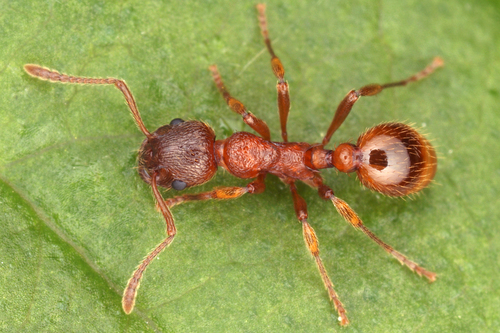
European fire ant
Myrmica rubra
Fierce, social, and strikingly red, the European fire ant is a tiny powerhouse of the garden floor. While famous for its potent sting, it is also a fascinating architect and a diligent guardian of the backyard ecosystem.
Quick Identification
Size
Workers: 4–6 mm (0.16–0.24 in); Queens: 5–7.5 mm (0.2–0.3 in)
Colors
Bright reddish-brown body with slightly darker pigmentation on the head and abdomen
Key Features
- Distinctive reddish-brown coloration with a darker head
- Two-segmented waist (petiole and post-petiole)
- Functional stinger at the end of the abdomen
- Aggressive response when nest is disturbed
When You’ll See Them
Geographic range
Where Does the European fire ant Live?
Originally native to the temperate regions of Europe and Northern Asia, the European fire ant is one of the most widespread ant species across the Palearctic. It can be found in high densities from the United Kingdom across to Central Asia. In recent decades, it has become a significant invasive species in North America, particularly in the Northeastern United States and the Atlantic provinces of Canada, where it thrives in moist, human-altered landscapes and outcompetes native ant species.
Basemap © OpenStreetMap contributors
Behavior
The European fire ant is well-known for its high levels of aggression and territoriality. Unlike many other ant species that flee when disturbed, Myrmica rubra workers are quick to swarm and use their stingers to defend their colony. Their sting is often compared to a stinging nettle, causing a sharp, burning sensation in humans that can last for several hours. They are highly social and often form super-colonies with multiple queens, a trait that allows them to reach incredibly high densities in favorable environments.
These ants are masters of the undergrowth, where they maintain a complex symbiotic relationship with aphids. They 'farm' these tiny insects, protecting them from predators in exchange for honeydew, a sugary secretion. In the backyard, you will often see them following invisible pheromone trails across patio stones or along the edges of garden beds as they move between their nest and various food sources.
EverydayEarth exclusive
Camera Tips
Capturing the European fire ant on camera requires a dedicated macro setup or a trail camera with a very close focal minimum. Because these ants are small and stay close to the ground, you should place your camera on a low-profile mount or directly on a flat stone. Position the lens just 2–5 inches away from a known 'highway' or trail—look for these along the edges of garden timber or the base of plants where aphids are present.
To create a focal point for your footage, use a 'bait station' method. Place a small bottle cap filled with sugar water or a dab of honey on a light-colored flat stone. The light background provides better contrast for the ant's reddish body. These ants are particularly attracted to protein as well, so a tiny piece of wet cat food or tuna can trigger 'recruitment behavior,' where you can film dozens of ants working together to dismantle and carry food back to the nest.
Since these ants are most active during the day but also move at night, check your camera's infrared settings. If the IR flash is too bright, it may wash out the detail on their shiny exoskeletons. Using a piece of semi-transparent tape over part of the IR LED can soften the light for close-up night shots. Mid-summer mornings after a light rain are the best times to capture high activity, as the ants emerge to forage in the humid air.
Frequently Asked Questions
Record European fire ant at your habitat
Connect a camera to start building your own species record — AI identifies every visitor automatically.