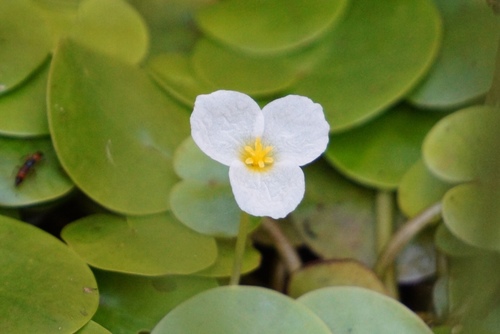
European Frog-bit
Hydrocharis morsus-ranae
A master of the still-water surface, the European Frog-bit transforms ponds with its carpet of heart-shaped leaves and delicate white blooms. While beautiful to behold, this resilient floater is a powerful ecosystem engineer that can reshape entire wetlands.
Quick Identification
Size
Leaves measure 1–6 cm (0.4–2.4 in) in width; flowers are approximately 1–2 cm (0.4–0.8 in) in diameter.
Colors
Bright green waxy leaves, often with reddish-purple undersides; flowers are white with three petals and a yellow spot at the base.
Key Features
- Small heart-shaped or kidney-shaped leaves
- Three-petaled white flowers with yellow centers
- Free-floating root system that does not anchor to the substrate
- Rapidly spreads via horizontal runners called stolons
When You’ll See Them
Geographic range
Where Does the European Frog-bit Live?
Native to Europe and parts of Western Asia, the European Frog-bit is widely distributed from the United Kingdom across to Central Asia. In recent decades, it has become a significant introduced species in North America, particularly throughout the Great Lakes region and the St. Lawrence River valley. It is now commonly found in the wild across Ontario, Quebec, New York, Michigan, and Vermont, where it thrives in temperate freshwater ecosystems.
Basemap © OpenStreetMap contributors
Behavior
European Frog-bit is a highly efficient free-floating aquatic plant that forms dense, interlocking mats on the surface of still waters. Unlike many water plants, it does not root into the mud at the bottom; instead, its roots dangle in the water column to absorb nutrients. During the growing season, it reproduces aggressively through vegetative fragmentation, using stolons to send out 'clones' that quickly cover available surface area.
As autumn approaches, the plant produces specialized winter buds called turions. These buds break off and sink to the bottom of the pond or lake to survive the freezing temperatures. In the spring, they become buoyant again, floating to the surface to start a new colony. While its thick mats can provide cover for small invertebrates, they often become so dense that they block sunlight and reduce oxygen levels for fish and native submersed plants.
EverydayEarth exclusive
Camera Tips
To capture the best footage of European Frog-bit, focus on time-lapse photography during the peak summer months of July and August. Use a waterproof action camera mounted on a stake just above the water line. Position the lens at a low angle to highlight the delicate three-petaled flowers, which stand slightly above the floating leaves. Because the flowers are ephemeral, setting a time-lapse interval of one photo every 5 minutes from 8:00 AM to 1:00 PM will allow you to record the beautiful process of the blooms opening to meet the sun.
Placement is key for AI-powered cameras; look for 'pockets' of open water within the green mats where flowers are more likely to emerge. If your camera is placed on a dock or a floating platform, ensure it is weighted properly to minimize wave-induced motion blur. Since this species is a plant, you won't need bait, but placing your camera near a known dragonfly or damselfly perch can add dynamic animal activity to your shots, as these insects frequently use the floating leaves as landing pads.
Pay close attention to lighting. The waxy surface of the leaves can cause harsh glare in direct midday sun. The 'blue hour' just after dawn or slightly overcast days provide the softest light, which helps reveal the subtle purple venation on the undersides of the leaves and the bright yellow centers of the flowers. If you are monitoring for invasive spread, keep the camera in a fixed position throughout the season to document how quickly the stolons extend and cover the water's surface.
Frequently Asked Questions
Record European Frog-bit at your habitat
Connect a camera to start building your own species record — AI identifies every visitor automatically.