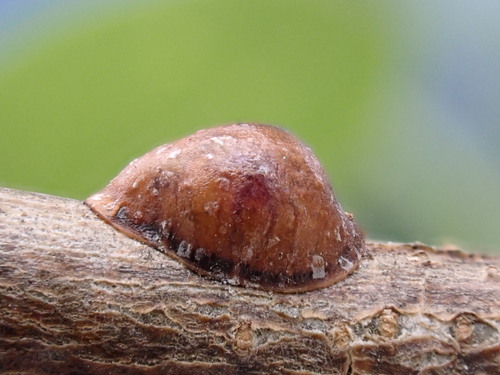
European Fruit Scale
Parthenolecanium corni
A common yet cryptic resident of North American orchards, the European Fruit Scale is a master of disguise. These sap-sucking insects resemble small, shiny bumps on tree bark, playing a quiet but significant role in the garden ecosystem.
Quick Identification
Size
Adult females: 3-6 mm (0.12-0.24 inches) long; Crawlers: less than 1 mm (0.04 inches)
Colors
Shiny reddish-brown to dark brown shell-like body; young nymphs are yellowish or pale green.
Key Features
- Hemispherical, dome-shaped outer shell
- Shiny reddish-brown to dark brown coloration
- Mature females resemble small bumps or scales on twigs
- Presence of sticky honeydew or black sooty mold on nearby leaves
When You’ll See Them
Geographic range
Where Does the European Fruit Scale Live?
Originally native to Europe, the European Fruit Scale has become a cosmopolitan species with a massive global footprint. It is now widely established across North America, particularly in the fruit-growing regions of California and the Pacific Northwest, as well as parts of Asia, South America, and North Africa. In the United States, it is a common inhabitant of both commercial orchards and backyard gardens wherever host trees are present.
Basemap © OpenStreetMap contributors
Behavior
The European Fruit Scale is a sedentary sap-sucking insect that spends most of its life fixed to the bark of fruit trees and woody ornamentals. In early spring, overwintering nymphs become active and mature into dome-shaped adult females. These females produce hundreds of eggs beneath their protective shells before dying, leaving the shell as a shield for the developing brood.
Once the eggs hatch, the tiny 'crawlers' emerge and migrate to the underside of leaves to feed on plant juices. While they are barely visible to the naked eye, their presence is often signaled by the secretion of honeydew—a sticky, sugary substance that coats leaves and fruit. This honeydew often attracts ants and leads to the growth of black sooty mold, which can interfere with the tree's ability to photosynthesize.
EverydayEarth exclusive
Camera Tips
Capturing the European Fruit Scale on a backyard camera requires a specialized approach since these insects are tiny and stationary for most of their lives. A camera with a dedicated macro lens or a high-resolution sensor capable of digital zoom is essential. Aim your camera at the underside of twigs or the crotches of branches on host trees like apricot, walnut, or plum, as these are the preferred sites for mature females to settle.
To document the lifecycle, set your camera to a time-lapse mode during the late spring (typically May or June) when the 'crawler' stage begins. This is the only time the insects are mobile, moving from the protective mother scale to the leaves. Positioning the camera 6 to 12 inches away from the branch with a neutral background will help the tiny yellowish crawlers stand out against the bark textures.
Lighting is the biggest challenge when filming scale insects. Use an external LED light source to provide side-lighting, which creates shadows and highlights the 3D 'bump' shape of the adult scales. This makes them much easier to distinguish from the natural texture of the bark. If you notice ants crawling up and down the tree, follow their path; they are often 'farming' the scale for honeydew and will lead you directly to the colony.
Avoid using motion-trigger settings alone, as the movement of the scales is too slow to activate most sensors. Instead, use scheduled intervals or manual triggers if your AI camera allows remote viewing. Monitoring the health of your backyard trees via these close-up shots can also serve as an early warning system for your garden's health, allowing you to spot infestations before they cause significant damage.
Similar Species
Species that look similar or are commonly confused with European Fruit Scale.
Frequently Asked Questions
Record European Fruit Scale at your habitat
Connect a camera to start building your own species record — AI identifies every visitor automatically.