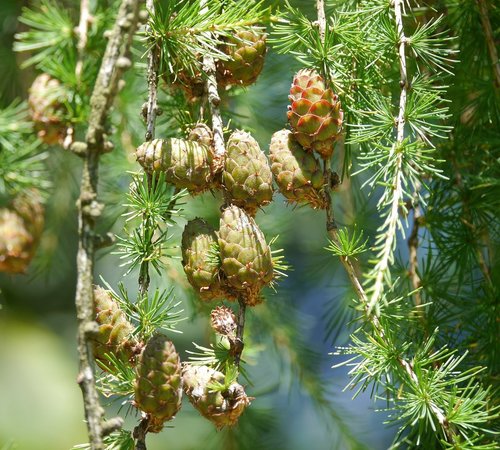
European larch
Larix decidua
The European Larch is a master of transformation, standing as the only native European conifer to shed its needles. From its soft emerald spring tufts to its legendary autumn gold, this 1,000-year-old mountain survivor is a centerpiece of alpine biodiversity.
Quick Identification
Size
Height of 25–45 metres (82–148 feet) with a trunk diameter up to 1.5 metres (5 feet).
Colors
Bright green needles in spring, turning deep golden-yellow in autumn; bark is grey-brown to pinkish-brown.
Key Features
- Deciduous conifer that sheds all needles in winter
- Soft needles grow in brush-like tufts of 30-40
- Small, egg-shaped cones that stand upright on twigs
- Deeply fissured, scaly bark on mature specimens
When You’ll See Them
Geographic range
Where Does the European larch Live?
Native to the rugged heart of central Europe, the European Larch is most at home in the high-elevation forests of the Alps and the Carpathian Mountains. Its primary range spans through Switzerland, Austria, northern Italy, and Romania, with unique lowland populations found in Poland. Because of its valuable timber and ornamental beauty, it has been widely introduced across the United Kingdom, Scandinavia, and the northeastern United States, where it often naturalizes in temperate woodlands.
Basemap © OpenStreetMap contributors
Behavior
The European Larch is a botanical anomaly: a conifer that behaves like a broadleaf tree. While its cousins like spruce and pine stay green year-round, the larch undergoes a spectacular seasonal transformation. In the spring, it produces soft, lime-green needles and bright pink 'larch roses' (female flowers). By autumn, the entire tree turns a brilliant, glowing gold before the needles drop to the forest floor, a strategy that helps it survive the heavy snows and extreme cold of high-altitude winters.
As a long-lived pioneer species, it is often the first to colonize rocky slopes or disturbed ground. It creates a light, airy canopy that allows enough sunlight to reach the ground for a diverse range of wildflowers and grasses to grow beneath it. This makes larch forests much more biodiverse than the dark, dense plantations of other evergreens. It also provides a vital nesting habitat for mountain birds and a steady food supply for specialized seed-eating wildlife.
EverydayEarth exclusive
Camera Tips
To capture the majesty of a European Larch, switch your trail camera from motion-trigger to Time-Lapse mode. Because the tree’s most dramatic changes happen over weeks rather than seconds, setting the camera to take one or two high-resolution photos per day—ideally around noon for consistent lighting—will allow you to create a stunning video of the tree 'waking up' in spring or turning gold in October. Secure the camera to a sturdy post or a neighboring tree at least 15-20 feet away to ensure the entire canopy is in the frame.
If you are interested in the wildlife that visits the tree, place your camera at chest height and angle it toward the lower trunk or the first few accessible branches. The deeply fissured bark of an older larch is a magnet for insects, which attracts Nuthatches, Treecreepers, and various Woodpeckers. Positioning the camera to look along a horizontal branch can capture these birds foraging. In the autumn, the cones become a primary target for Red Squirrels and Crossbills; focusing on a cone-heavy branch during the morning hours can yield excellent action shots.
Be mindful of the sun’s position throughout the year. Because the larch is often found in open areas or on slopes, backlighting can be a major issue, especially when the needles turn golden and reflect light. Aim your camera North or South to avoid the direct glare of the rising or setting sun. In winter, the bare branches can be difficult for some autofocus systems to lock onto; if your camera allows, set a manual focus point or ensure there is a high-contrast object (like the main trunk) in the center of the frame.
Similar Species
Species that look similar or are commonly confused with European larch.
Japanese Larch
Has distinct reddish-brown winter twigs and cone scales that curl outward (reflexed) like the petals of a rose.
Tamarack
A smaller North American relative that grows primarily in wet bogs and swamps, whereas the European species prefers well-drained mountain slopes.
Norway Spruce
Shares the same alpine habitat but is strictly evergreen, with darker green needles that do not grow in tufts.
Frequently Asked Questions
Record European larch at your habitat
Connect a camera to start building your own species record — AI identifies every visitor automatically.