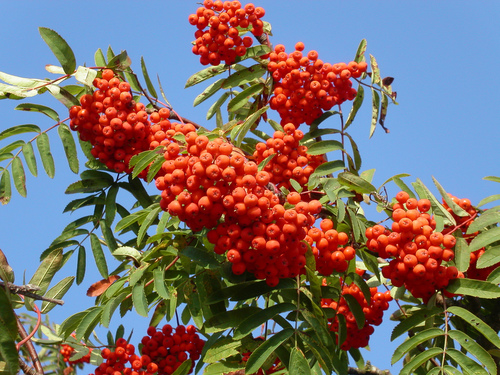
European mountain ash
Sorbus aucuparia
A beacon for backyard birds, the European mountain ash provides a vibrant splash of color and a vital food source for wildlife. Known as the Rowan, this resilient tree is the ultimate centerpiece for any nature-lover's garden.
Quick Identification
Size
Typically 8–15 m (26–49 ft) tall, with a canopy spread of 4–8 m (13–26 ft)
Colors
Smooth silvery-gray bark; dark green leaves with pale undersides; creamy white flower clusters; vibrant orange to scarlet berries
Key Features
- Compound pinnate leaves with 11-15 serrated leaflets
- Dense clusters (corymbs) of white five-petaled flowers
- Heavy bunches of bright orange-red pomes (berries) in autumn
- Smooth grayish bark that becomes slightly fissured with age
When You’ll See Them
Geographic range
Where Does the European mountain ash Live?
The European mountain ash is native to nearly all of Europe, ranging from the Arctic Circle in Scandinavia down to the mountain ranges of North Africa. It is a staple of the landscape in the United Kingdom, Ireland, and Central Europe, extending eastward into Siberia and Western Asia. In North America, it has been widely introduced as an ornamental tree and has naturalized in many northern states and Canadian provinces, where it thrives in climates that mimic its cool, moist native high-altitude haunts.
Basemap © OpenStreetMap contributors
Behavior
The European mountain ash, widely known as the Rowan, is a hardy deciduous tree that serves as a cornerstone of temperate ecosystems. Unlike more aggressive forest giants, the Rowan is a pioneer species, often the first to colonize cleared land or high-altitude rocky soils. It has a relatively short lifespan for a tree, usually reaching 70 to 100 years, but it compensates with high reproductive output, producing thousands of nutrient-rich berries every autumn.
Ecologically, the tree acts as a vital hub for neighborhood wildlife. In the spring, its heavy scent attracts a wide variety of pollinators, including bees and hoverflies. By late summer and autumn, the tree becomes a frenetic feeding station for birds. The berries are high in vitamin C and energy, providing crucial fuel for migrating species and resident birds preparing for winter. In folklore, the Rowan was often planted near homes to ward off evil spirits, a testament to its long-standing relationship with human settlements.
EverydayEarth exclusive
Camera Tips
Capturing the European mountain ash on a trail camera is less about the tree itself and more about the incredible avian drama it hosts. To get the best results, mount your camera using a high-angle attachment or a sturdy tripod aimed directly at a major cluster of ripening berries. Because these trees can be tall, look for younger specimens or lower-hanging branches to keep the action within the focal range of your lens (usually 3-6 feet for backyard AI cameras).
Timing is critical. Set your camera to 'Burst Mode' or 'High Sensitivity' during the late summer and autumn months. This is when the tree becomes a magnet for 'irruptive' species like Waxwings or various thrushes. Because birds move quickly when feeding, a high shutter speed or a camera with a fast trigger time (under 0.5 seconds) is essential to avoid blurry shots of flapping wings. If your camera has AI bird identification, the Rowan is the perfect place to test it, as the bright red background of the berries provides excellent contrast for the sensors.
Consider the lighting carefully. Rowan berries look most spectacular in the 'golden hour' of early morning or late afternoon sun. Position your camera facing north or south to avoid direct lens flare from the sun while maximizing the natural light hitting the fruit. In winter, if the berries persist through the first frost, keep the camera active; the fermented berries can lead to some very entertaining and high-energy bird behavior as they compete for the last of the seasonal sugar.
Similar Species
Species that look similar or are commonly confused with European mountain ash.
Frequently Asked Questions
Record European mountain ash at your habitat
Connect a camera to start building your own species record — AI identifies every visitor automatically.