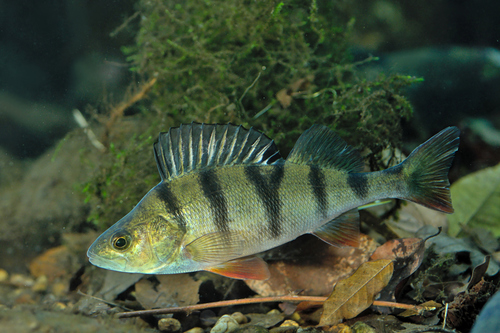
European Perch
Perca fluviatilis
Strikingly striped and bold, the European Perch is a master of the underwater ambush. With its vibrant red fins and iconic dark bars, this hardy predator is a fascinating resident of rivers, lakes, and large garden ponds.
Quick Identification
Size
Typically 25-40 cm (10-16 in) and 0.5-1 kg (1.1-2.2 lb); can reach 60 cm (24 in) and 4.8 kg (10.6 lb)
Colors
Olive-green back transitioning to brassy-yellow flanks with 5-9 dark vertical bars; bright orange to blood-red pelvic and anal fins
Key Features
- 5-9 prominent dark vertical bands along the flanks
- Bright orange or red pelvic and anal fins
- Two separate dorsal fins, the first having 13-17 sharp spines
- Large dark spot at the rear of the first spiny dorsal fin
When You’ll See Them
Geographic range
Where Does the European Perch Live?
Native to the vast freshwater systems of Europe and Northern Asia, the European Perch is a dominant and widespread species across the Palearctic. Its core range spans from the United Kingdom and France across Central and Eastern Europe, extending deep into the river basins of Russia and Siberia. In Northern Europe, they are found throughout the Scandinavian Peninsula and Finland, even tolerating the brackish waters of the Baltic Sea. Beyond its original home, this hardy fish has established significant populations in Australia, New Zealand, and South Africa, where it was introduced for sport fishing.
Basemap © OpenStreetMap contributors
Behavior
European Perch are highly adaptable predators that exhibit shifting social behaviors throughout their lives. Juveniles are extremely gregarious, forming large, synchronized shoals in shallow waters to minimize predation risk while they forage for zooplankton and small invertebrates. These shoals are often a spectacle of movement near reed beds and submerged structures.
As they mature, perch become more solitary and territorial. Large adults, often referred to as 'specimen' perch, usually hunt alone or in very small groups of similar-sized fish. They are primarily diurnal, relying on their excellent vision to ambush prey. Their inquisitive nature makes them quite bold, often investigating new objects in their environment, which makes them excellent subjects for underwater observation and photography.
EverydayEarth exclusive
Camera Tips
To capture the stunning patterns of the European Perch on a backyard or pond camera, your primary focus should be on water clarity and lighting. Position your underwater camera in a shallow area—ideally 0.5 to 1.5 meters deep—where natural sunlight can reach the bottom. Aim your lens toward 'structure' like submerged logs, large stones, or the edge of a reed bed. Perch are ambush hunters that love to hover near cover, making these locations the perfect stage for high-quality footage.
If you are using an action camera or a specialized underwater trail cam, avoid pointing it directly toward the sun to prevent lens flare and silhouetting. Instead, angle the camera so the light comes from behind the lens, which will maximize the color contrast of the fish's iconic red fins against the background. In murkier water, you can often entice a perch closer to the lens by suspending a shiny, non-functional fishing lure or a small piece of worm just within the frame; their natural curiosity will often draw them in for a close-up inspection.
Because perch hunting activity peaks during 'crepuscular' hours, early morning and late afternoon are the best times for recording. During these periods, perch move from deeper water into the shallows to hunt, providing the most dynamic action. If your device supports high-speed recording, use a setting like 60 or 120 frames per second. Perch strikes are lightning-fast, and a higher frame rate allows you to see the incredible way they flare their gills to suction-feed on their prey in slow motion.
In seasonal terms, the best footage is usually captured from late spring through early autumn when the water is warmer and the fish are most active. During winter, they tend to move to deeper, calmer water where they become more lethargic. If you are monitoring a garden pond, ensure the camera is placed away from heavy aeration or fountains, as the bubbles can confuse AI motion sensors and obscure the view of the fish.
Similar Species
Species that look similar or are commonly confused with European Perch.
Zander
Much larger and more elongated with a silver-grey body, lacking the bold vertical stripes and red fins of the perch.
Yellow Perch
The North American counterpart; very similar but generally smaller and more golden-yellow, lacking the dark spot at the base of the tail found on European specimens.
Ruffe
A smaller relative with a single continuous dorsal fin and a more brownish, mottled appearance without the distinct vertical stripes.
Frequently Asked Questions
Record European Perch at your habitat
Connect a camera to start building your own species record — AI identifies every visitor automatically.