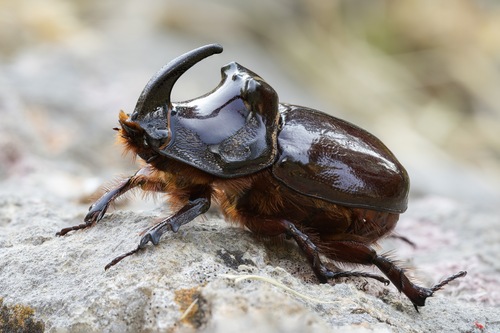
European Rhinoceros Beetle
Oryctes nasicornis
A prehistoric-looking titan of the undergrowth, the European Rhinoceros Beetle is one of the most impressive insects you can find in your backyard. Known for the male's iconic horn and its glossy armor, this gentle giant is a master of the compost heap.
Quick Identification
Size
25–45 mm (1–1.8 inches) in length; larvae can grow up to 10 cm (4 inches)
Colors
Dark mahogany to glossy black; males have a prominent backward-curved horn; underside covered in fine reddish hairs
Key Features
- Large, backward-curved cephalic horn on males
- Glossy, lacquer-like chestnut or black exoskeleton
- Spined, powerful legs adapted for digging
- Smooth, domed wing covers (elytra)
When You’ll See Them
Geographic range
Where Does the European Rhinoceros Beetle Live?
Native to the Palearctic realm, the European Rhinoceros Beetle is widely distributed across the European continent, from the Mediterranean shores of Spain and Italy up to the southern reaches of Scandinavia. Its presence extends across North Africa and through the Middle East into Central Asia and Siberia. In many parts of its range, it has successfully adapted to human-altered landscapes, thriving in urban parks and garden compost heaps where natural forest floor habitats have vanished.
Basemap © OpenStreetMap contributors
Behavior
The European Rhinoceros Beetle is a nocturnal giant that spends the majority of its life as a larva hidden underground or within decaying organic matter. As adults, they emerge during the warm summer months with a primary mission: reproduction. Despite their intimidating horn and heavy armor, they are entirely harmless to humans, possessing no sting and very little interest in anything other than finding a mate.
During the day, they remain hidden under logs, leaf litter, or within compost heaps to avoid predators. At dusk, they become active, often taking to the air with a loud, low-pitched buzzing sound. Their flight is somewhat clumsy and heavy, and they are frequently drawn to artificial light sources, which is often how they end up in suburban backyards or near porch lights.
EverydayEarth exclusive
Camera Tips
To capture the European Rhinoceros Beetle on camera, focus your efforts on 'emergence zones' like large compost heaps, woodchip piles, or decaying oak logs. These beetles are heavy and tend to crawl for a distance before taking flight, so placing your camera 10-15 centimeters off the ground near these features is ideal. Use a macro lens or a camera with a short minimum focus distance, as these beetles are detail-rich subjects that look best in close-up.
Since they are strictly nocturnal, your camera's infrared (IR) performance is critical. However, because their exoskeleton is highly reflective and glossy, standard IR flashes can cause 'white-out' glare. If your camera settings allow, reduce the flash intensity or use a diffuser. Alternatively, setting up a low-intensity UV light or 'blacklight' nearby can act as a natural lure, as these beetles are highly phototactic and will often land near the light source, allowing for consistent monitoring.
Time your camera deployments for warm, humid evenings in mid-summer, particularly after a light rain which often triggers increased activity. Because the adult life stage is short—lasting only a few weeks—you should check your camera daily during July. If your camera has a video mode, use it; watching the slow, deliberate movement and the effort they take to launch into flight is much more rewarding than a still image alone.
Similar Species
Species that look similar or are commonly confused with European Rhinoceros Beetle.
Frequently Asked Questions
Record European Rhinoceros Beetle at your habitat
Connect a camera to start building your own species record — AI identifies every visitor automatically.