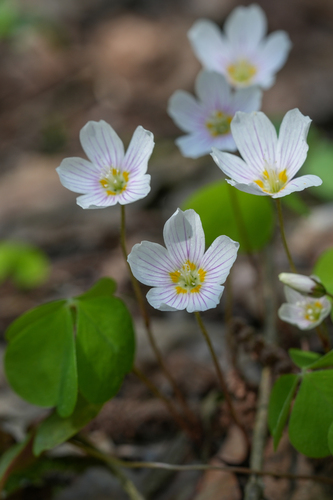
European wood-sorrel
Oxalis acetosella
Meet the delicate 'sleeping' beauty of the forest floor, a resilient wildflower known for its heart-shaped leaves and explosive seed dispersal. The European wood-sorrel is a master of the shadows, bringing a touch of white and lilac to the darkest woodland corners.
Quick Identification
Size
Height: 5–15 cm (2–6 inches); Leaf width: 1–2 cm (0.4–0.8 inches)
Colors
Bright green leaves; white flowers with delicate lilac or pink veins and a yellow base
Key Features
- Three heart-shaped leaflets joined at the points
- Solitary white flowers with five notched petals
- Leaves fold downward at night or in rain
- Reddish-purple tinged stems and rhizomes
When You’ll See Them
Geographic range
Where Does the European wood-sorrel Live?
The European wood-sorrel is a quintessential inhabitant of the temperate and boreal forests of Eurasia. Its native range is vast, stretching from the Atlantic coasts of Ireland and the United Kingdom across the heart of Europe into the deep taiga of Russia, eventually reaching as far east as Japan. While it is most at home in the cool, moist interiors of primary forests, it has also established small naturalized populations in parts of North America where the climate mimics its cool, northern origins.
Basemap © OpenStreetMap contributors
Behavior
European wood-sorrel is famous for its 'sleep movements,' or nyctinasty. As light levels drop at dusk or when the plant is stressed by heavy rain, the heart-shaped leaflets fold downward against the stem, resembling a closed umbrella. This behavior is thought to protect the delicate foliage from nighttime chill or damage from precipitation. During the day, the leaves expand to capture the limited sunlight filtering through the forest canopy, often orienting themselves to maximize exposure.
The species also exhibits an fascinating method of seed dispersal known as ballochory. When the seed capsules ripen, internal pressure builds up until they explode, catapulting the small seeds several feet away from the parent plant. This ensures the next generation finds fresh soil and avoids competing with the established colony. It is a slow-colonizing species, often used by ecologists as an indicator of ancient woodland, as it spreads primarily through its creeping, scaly rhizomes.
EverydayEarth exclusive
Camera Tips
Capturing the European wood-sorrel on a trail camera requires a specialized approach because of its low profile and subtle movements. To capture its unique daily cycle, set your camera on a time-lapse mode rather than a motion-triggered mode. Aim for an interval of one frame every 5 to 10 minutes. Place the camera on a mini-tripod or a low mount just 10-15 centimeters (4-6 inches) off the ground, angled slightly downward toward a healthy cluster of leaves. This will allow you to see the dramatic 'folding' movement as the sun sets.
Lighting is crucial for this species. Because it grows in deep shade, the forest floor can be quite dark, which may cause your camera to use grainy high-ISO settings. Try to position your camera in a spot where 'sun flecks'—tiny patches of direct light—hit the plant during the early afternoon. This provides a natural spotlight and brings out the delicate purple veining in the white petals. Avoid using a heavy flash at close range, as it will wash out the translucent texture of the petals; a diffused LED fill light is much better if the canopy is particularly dense.
For the best results, monitor the weather forecast and set your camera during the peak flowering window of April to May. Rain can actually provide excellent footage; while most wildlife hides, the wood-sorrel reacts visibly to the raindrops by folding its leaves. Ensure your camera lens is treated with an anti-fog coating, as the damp, mossy environments where this plant thrives are prone to high humidity that can cloud your glass. If your AI camera supports macro focus, ensure it is enabled to capture the intricate yellow 'honey guides' at the center of the flowers.
Similar Species
Species that look similar or are commonly confused with European wood-sorrel.
Frequently Asked Questions
Record European wood-sorrel at your habitat
Connect a camera to start building your own species record — AI identifies every visitor automatically.