False Map Turtle
Graptemys pseudogeographica
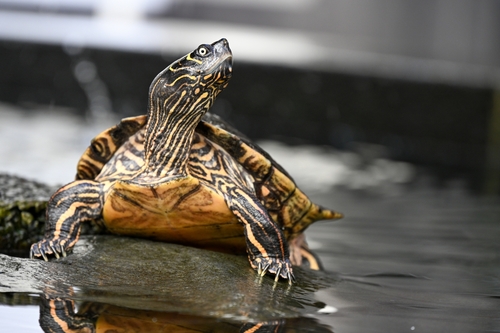
Master of the river sun-loungers, the False Map Turtle is a master of camouflage with a shell that looks like a hand-drawn topographic map.
Quick Identification
Size
Males 3.5–5.75 in (9–15 cm); Females 5–10.75 in (13–27 cm)
Colors
Olive to brown shell with yellow 'contour map' lines; cream plastron; yellow 'L' mark behind eye
Key Features
- Serrated 'saw-toothed' rear edge of the shell
- Prominent dark-tipped keel or ridge along the center of the back
- Narrow yellow lines on head and limbs resembling a topographic map
When You’ll See Them
Geographic range
Where Does the False Map Turtle Live?
The False Map Turtle is native to the North American continent, specifically localized within the massive river systems of the central United States. Its core range follows the intricate paths of the Missouri and Mississippi River basins, stretching from the Great Lakes region in the north down to the Gulf Coast of Louisiana and East Texas. While they are primarily found in these central states, small introduced populations occasionally appear in other regions due to their popularity in the pet trade.
Basemap © OpenStreetMap contributors
Behavior
False Map Turtles are renowned basking enthusiasts, spending significant portions of their day perched on logs, rocks, or brush piles to regulate their body temperature. They are incredibly wary and possess keen eyesight; at the first sign of a predator or a curious human, the entire group will slide silently back into the water. Despite this skittishness, they are quite social and are often seen 'stacking' on top of one another to secure the best sun-drenched spots.
In the water, they are strong swimmers that prefer large rivers with moderate currents, though they also frequent oxbow lakes and sloughs. During the winter months, they enter a state of brumation, settling into the mud at the bottom of deep pools or wedging themselves under submerged logs where oxygen levels remain stable.
EverydayEarth exclusive
Camera Tips
Capturing the False Map Turtle requires a focus on their basking habits rather than their underwater life. Look for 'turtle logs'—fallen trees that extend from the bank into the water and receive direct sunlight for several hours a day. Position your camera on a nearby tree or a sturdy stake, aiming downward at the log. Since these turtles are extremely sensitive to movement, using a remote camera is often the only way to see them behaving naturally without them diving into the safety of the water.
Standard motion sensors can be hit-or-miss with reptiles because they are cold-blooded and may not trigger the PIR sensor. To solve this, I highly recommend using a 'Time Lapse' mode. Set your camera to take a photo every 2 to 5 minutes between 10:00 AM and 3:00 PM. This 'set it and forget it' approach is almost guaranteed to capture turtles as they climb out to dry off. If your camera supports a hybrid 'Time Lapse + Motion' mode, use it to ensure you catch any interesting behavioral interactions or movement between individuals.
In terms of framing, try to get as close as the camera's minimum focal distance allows. Map Turtles have beautiful, intricate patterns on their shells and heads that look stunning in high-resolution photos. Ensure your camera is well-camouflaged with natural vegetation or a camo-wrap, as any shiny surfaces or unnatural shapes can deter them from using a specific log. Avoid using flash; the natural midday sun provides the best lighting for revealing the 'map' lines on their carapaces.
Similar Species
Species that look similar or are commonly confused with False Map Turtle.
Frequently Asked Questions
Record False Map Turtle at your habitat
Connect a camera to start building your own species record — AI identifies every visitor automatically.