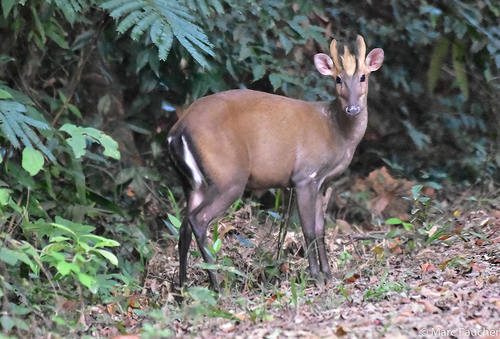
Fea's Muntjac
Muntiacus feae
An elusive ghost of the Tenasserim mountains, the Fea's Muntjac is a rare, dark-coated deer famous for its golden crown and secretive lifestyle.
Quick Identification
Size
Length: 80–100 cm (31–39 in); Shoulder height: 50–60 cm (20–24 in); Weight: 18–25 kg (40–55 lbs)
Colors
Rich dark brown to blackish coat; crown of the head is distinctly yellowish or golden; tail is dark on top and white underneath.
Key Features
- Golden-yellow hair on the crown of the head
- Small antlers on long, fur-covered pedicels (males only)
- Dark brown to nearly black body fur
- Long, visible canine tusks in males used for defense
When You’ll See Them
Geographic range
Where Does the Fea's Muntjac Live?
Fea's Muntjac is native to the continent of Asia, with a highly restricted range focused within the Tenasserim Hills. It is primarily found in the border regions between southern Myanmar and western Thailand. Unlike the more common red muntjac, this species is a habitat specialist that remains confined to these specific upland forest corridors, making it one of the rarest deer in the region.
Basemap © OpenStreetMap contributors
Behavior
Socially, these animals are rarely seen in groups. They are highly territorial, and interactions between individuals are usually limited to mating or brief skirmishes between males using their tusks. Females are dedicated mothers, often giving birth in the thickest vegetation available to ensure the fawn remains hidden from predators like leopards or dholes until it is strong enough to keep pace with her.
EverydayEarth exclusive
Camera Tips
To capture high-quality footage of Fea's Muntjac, camera placement is critical due to their small stature and shy nature. Mount your camera no higher than 18 to 24 inches (45-60 cm) off the ground. Aiming the camera slightly downward along a known game trail or near a natural salt lick will yield the best results. Because they are diurnal, ensure your camera's daylight sensor is optimized and that the lens isn't facing directly into the morning or evening sun, which can wash out the dark details of their coat.
These deer are most frequently found near water sources in upland areas, especially during the dry season. Placing a camera near a small forest seep or a quiet creek bank can increase your chances of a sighting. Use a high-speed trigger setting (0.3 seconds or faster) because muntjacs are notorious for 'skipping' through the frame; a slow trigger will often only capture the white flash of their disappearing tail.
While they are wild animals, in areas where they are known to roam, providing a consistent source of mineral-rich substrate or a salt block can encourage them to linger in front of the camera. However, the best 'lure' is simply maintaining a quiet, undisturbed environment. Avoid visiting the camera site too frequently, as the scent of humans will drive this sensitive species deeper into the evergreen thickets for several days.
During the monsoon season, look for high-traffic 'tunnels' through the shrubbery. Fea's Muntjac prefers these covered paths over open clearings. If your camera has a video mode with audio recording, keep it active; you might capture their unique 'bark,' which is often the first sign that one is nearby even if it remains just out of the visual frame.
Similar Species
Species that look similar or are commonly confused with Fea's Muntjac.
Frequently Asked Questions
Record Fea's Muntjac at your habitat
Connect a camera to start building your own species record — AI identifies every visitor automatically.