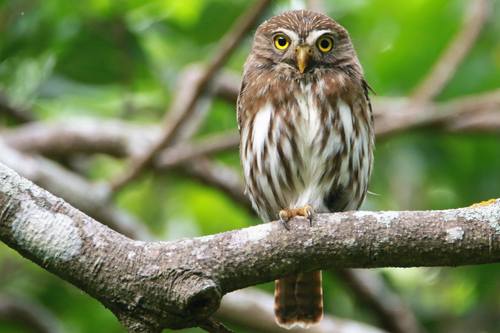
Ferruginous Pygmy-Owl
Glaucidium brasilianum
The Ferruginous Pygmy-Owl is a pint-sized powerhouse of the bird world, known for its fierce hunting skills, daytime activity, and the uncanny 'false eyes' on the back of its head.
Quick Identification
Size
Length: 15–17 cm (5.9–6.7 in); Wingspan: 35–41 cm (14–16 in); Weight: 62–80 g (2.2–2.8 oz)
Colors
Upperparts range from rufous (rusty-red) to gray-brown with white-streaked crowns. Underparts are white with heavy vertical streaks of the primary body color. Prominent black-and-white 'false eyes' on the nape.
Key Features
- Two black 'false eye' spots on the back of the neck
- White vertical streaks on the crown (not spots like other pygmy-owls)
- Proportionally long, barred tail often held at an upward angle
- Stocky, earless head with yellow eyes and a yellowish beak
When You’ll See Them
Geographic range
Where Does the Ferruginous Pygmy-Owl Live?
Native to the Western Hemisphere, the Ferruginous Pygmy-Owl boasts an expansive range that begins in the southwestern United States and extends through Mexico and Central America deep into South America, reaching as far south as central Argentina. Within the United States, they are highly localized specialists found primarily in the mesquite thickets of south-central Arizona and the lower Rio Grande Valley of southern Texas. Because they are non-migratory, these owls remain in their established territories throughout the year across their entire range from the Sonoran Desert to the Brazilian rainforests.
Basemap © OpenStreetMap contributors
Behavior
Unlike many of their nocturnal cousins, Ferruginous Pygmy-Owls are frequently active during the day, making them a favorite for backyard birders. They are exceptionally bold and aggressive for their size, often preying on animals larger than themselves. Their hunting style involves sitting motionless on a perch before making a rapid, direct flight to snatch insects from the air or pounce on small vertebrates on the ground.
These owls are highly territorial and use a distinctive series of monotonous, hollow-sounding whistles to mark their domain. One of their most fascinating defensive traits is the pair of 'ocelli' or false eyes on the back of their head. These markings are thought to deter predators or 'mobbing' songbirds by tricking them into thinking the owl is watching them, even when its back is turned. While they are generally solitary, they form strong pair bonds during the breeding season and nest in natural tree cavities or abandoned woodpecker holes.
EverydayEarth exclusive
Camera Tips
To capture high-quality footage of a Ferruginous Pygmy-Owl, focus your camera on transitional edges where dense scrub meets open clearings. These owls love to perch on the outer branches of mesquite or acacia trees about 5 to 10 feet off the ground while scanning for prey. Set your camera at a slight upward angle to capture their underside and tail-flicking behavior, which is a key identification marker.
Because they are diurnal and crepuscular, you don't need to rely solely on infrared night vision. Position your camera to take advantage of the 'golden hour' light in the early morning or late afternoon. If you have a bird feeder that attracts small songbirds or a water feature, place a camera nearby; Ferruginous Pygmy-Owls are often drawn to these areas, not for the seeds, but for the birds and lizards that congregate there. They are also known to bathe in shallow water during the heat of the day.
Using a fast shutter speed or a high-frame-rate video setting is crucial because their strikes are lightning-fast. If your camera supports 'Pre-Trigger' or 'Buffering' recording, enable it so you don't miss the moment they launch from a perch. In backyard settings, they are particularly fond of nesting in old woodpecker holes in Saguaro cacti or large trees, so a camera aimed at a cavity entrance during the spring (March–June) can provide incredible footage of adults bringing food to the nest.
While audio lures (playback calls) can be effective in bringing them closer, use them sparingly and ethically, as over-calling can stress the birds and distract them from hunting or defending their territory. Instead, focus on providing a 'perch-rich' environment with natural, horizontal branches that provide a clear line of sight for the owl's hunt.
Similar Species
Species that look similar or are commonly confused with Ferruginous Pygmy-Owl.
Frequently Asked Questions
Record Ferruginous Pygmy-Owl at your habitat
Connect a camera to start building your own species record — AI identifies every visitor automatically.