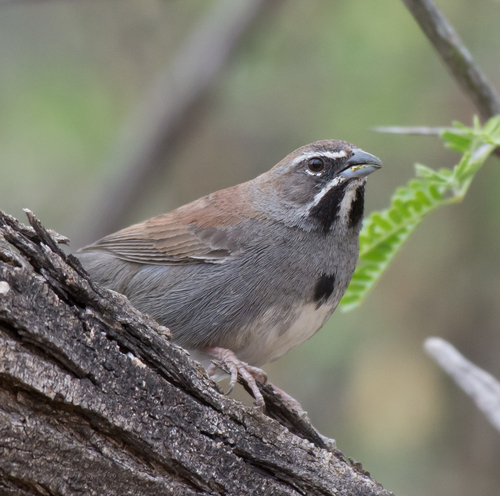
Five-striped Sparrow
Amphispizopsis quinquestriata
A rare resident of the rugged canyons along the U.S.-Mexico border, the Five-striped Sparrow is a master of the thorny thicket. With its striking facial patterns and elusive nature, it remains a bucket-list species for many backyard observers and wildlife enthusiasts.
Quick Identification
Size
Length: 13–15 cm (5.1–5.9 in); Wingspan: 20–22 cm (7.9–8.7 in); Weight: 16–22 g (0.56–0.78 oz)
Colors
Slate-gray head and breast with a small black central spot. The face features five distinct white stripes: one above the eye, one on the cheek, and one on the malar area. The back and wings are warm brown, and the belly is white.
Key Features
- Five white facial stripes on a slate-gray head
- Small, distinct black spot in the center of the breast
- Long, rounded tail often flicked nervously
- Rich brown upperparts contrasting with gray underparts
When You’ll See Them
Geographic range
Where Does the Five-striped Sparrow Live?
This specialty bird is native to North America, primarily occupying the western slopes of the Sierra Madre Occidental in Mexico. Its core range spans from the Mexican states of Jalisco and Nayarit north through Sonora. In the United States, it is a highly localized resident found only in a handful of remote, brushy canyons in southernmost Arizona, making it one of the most sought-after 'borderlands' species for birdwatchers.
Basemap © OpenStreetMap contributors
Behavior
The Five-striped Sparrow is a secretive and somewhat elusive species, spending much of its time tucked away in the dense undergrowth of thorny scrub and steep canyon hillsides. Unlike many other sparrows that forage in the open, this species prefers the protection of thickets, where it hops through leaf litter to find food. It is highly territorial during the breeding season, which uniquely aligns with the summer monsoon rains in the desert Southwest.
While they are generally shy around humans, males become remarkably bold during the summer months. To defend their territory and attract mates, they choose prominent perches atop mesquite or ocotillo to deliver their complex, metallic songs. Outside of the breeding season, they are quiet and difficult to locate, often moving in pairs or small family groups through the shadows of rocky ravines.
EverydayEarth exclusive
Camera Tips
To capture the elusive Five-striped Sparrow on a trail camera, you must focus on their preferred ground-level pathways. These birds rarely fly across open spaces, preferring to hop through dense cover. Place your camera very low to the ground—about 12 inches high—near the base of a steep, rocky slope or at the edge of a thicket. If you can find a small opening in the brush where leaf litter has accumulated, that is an ideal spot for a 'set and forget' camera trap.
Water is a powerful attractant for this species, especially in their arid desert habitats. A low-profile, solar-powered water dripper or a simple shallow basin placed in front of your camera can yield excellent results. Because these sparrows are nervous and move with quick, jerky motions, set your camera to a high trigger speed or use a video mode with at least 30 frames per second to avoid motion blur. A 15-second video clip is usually perfect for capturing their characteristic tail-flicking and foraging behavior.
During the peak activity of the summer monsoons, keep an eye out for 'singing posts.' If you see a male repeatedly using the same branch or shrub top to sing, you can mount a camera on a nearby taller plant, angled downward, to get rare eye-level footage of their territorial displays. Because of the intense summer heat in their range, ensure your camera is positioned in a shaded spot to prevent sensor malfunctions and to ensure the lighting on the bird is even and not washed out by harsh midday sun.
Similar Species
Species that look similar or are commonly confused with Five-striped Sparrow.
Frequently Asked Questions
Record Five-striped Sparrow at your habitat
Connect a camera to start building your own species record — AI identifies every visitor automatically.