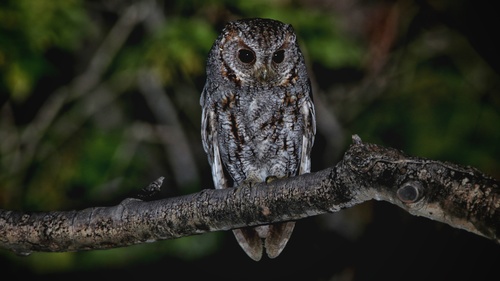
Flammulated Owl
Psiloscops flammeolus
Meet the 'Pinecone Owl,' a tiny, dark-eyed master of disguise that migrates thousands of miles across the Americas. This elusive insect-hunter is one of the forest's best-kept secrets, blending perfectly into the bark of ancient pines.
Quick Identification
Size
Length: 15–17 cm (6–7 in); Wingspan: 36–41 cm (14–16 in); Weight: 45–63 g (1.6–2.2 oz)
Colors
Cryptic variegated gray, brown, and rust (cinnamon) plumage; distinctive dark chocolate-brown to black eyes; subtle 'flame' shaped rufous markings on the shoulders.
Key Features
- Distinctive dark brown or black eyes (unique among small North American owls)
- Tiny size, roughly equivalent to a large pinecone
- Small, inconspicuous ear tufts that are often held flat
- Intricate bark-like camouflage with cinnamon-colored highlights
When You’ll See Them
Geographic range
Where Does the Flammulated Owl Live?
These secretive owls are native to the mountainous regions of Western North America, stretching from southern British Columbia through the United States and down into the highlands of Mexico and Guatemala. During the summer, their core range focuses on the interior mountain ranges of the American West, including the Rockies and the Sierras. Because they are Neotropical migrants, they vanish from their northern territories in the fall, heading south to find warmer climates where insects remain active year-round.
Basemap © OpenStreetMap contributors
Behavior
The Flammulated Owl is a master of camouflage and a ghost of the western forests. Unlike many of its cousins, this tiny owl is almost entirely insectivorous, spending its nights hunting moths and beetles in the canopy. They are strictly nocturnal and incredibly shy, often pressing their bodies against tree trunks to mimic bark when they feel threatened, making them nearly impossible to spot during the day.
During the breeding season, they are highly territorial, but because their calls are so low-pitched, they often sound like a much larger bird from a distance. While they rarely interact with humans directly, they are dependent on old-growth forests and the presence of woodpecker cavities for nesting. Their migration is one of the most impressive of any North American owl, traveling thousands of miles to reach their wintering grounds in Central America.
EverydayEarth exclusive
Camera Tips
Capturing a Flammulated Owl on camera requires patience and specific placement since they rarely descend to the ground. Your best bet is to mount your AI-powered camera high on the trunk of a mature Ponderosa pine or Douglas fir, specifically targeting heights of 10 to 20 feet. Angle the camera slightly downward to monitor potential nesting cavities—specifically old Northern Flicker or Sapsucker holes. Because these owls are so small and match the bark perfectly, use a camera with a high-sensitivity infrared sensor and 4K resolution to pick up their subtle movements against the tree bark.
Since they are strictly insectivorous, traditional birdseed or suet won't work as a lure. Instead, consider placing your camera near a 'moth light' or a backyard area where night-flying insects congregate. They are also known to visit shallow, elevated birdbaths in dry montane environments during the heat of summer. Position your camera to overlook the water source, as a quick midnight bath is one of the few times they are vulnerable and visible out in the open.
Set your camera to 'Night Mode' with a fast trigger speed, as their flight is swift and silent. The best time to capture activity is between late May and July when the males are vocal and hunting frequently to feed nesting females and owlets. Because their call is a low-frequency 'hoot' that can travel far, use the audio detection feature on your AI camera to trigger recording; the software can often identify the specific pitch of a Flammulated Owl even before it enters the frame.
Similar Species
Species that look similar or are commonly confused with Flammulated Owl.
Western Screech-Owl
Larger than the Flammulated Owl with bright yellow eyes and more prominent ear tufts.
Northern Pygmy-Owl
Frequently active during the day and has yellow eyes with a distinct 'false eye' pattern on the back of its head.
Elf Owl
Even smaller than the Flammulated Owl, with yellow eyes and a preference for desert scrub and cactus habitats.
Frequently Asked Questions
Record Flammulated Owl at your habitat
Connect a camera to start building your own species record — AI identifies every visitor automatically.