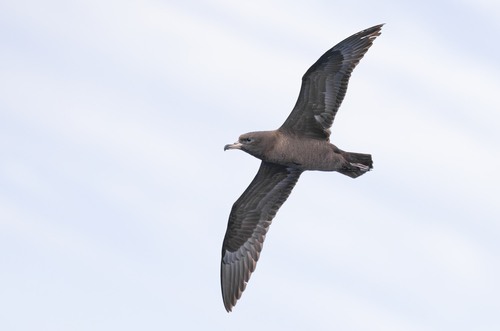
Flesh-footed Shearwater
Ardenna carneipes
A master of the open ocean, the Flesh-footed Shearwater is a long-distance traveler known for its distinct pink bill and impressive trans-equatorial migrations.
Quick Identification
Size
Length: 40–45 cm (16–18 in); Wingspan: 99–107 cm (39–42 in); Weight: 550–750 g (1.2–1.6 lbs)
Colors
Uniform dark chocolate-brown to blackish-brown plumage; pale pinkish or straw-colored bill with a distinct black tip; pale pink feet and legs.
Key Features
- Uniform dark chocolate-brown plumage
- Pale pinkish bill with a hooked black tip
- Flesh-colored pink feet and legs
- Broad wings with a heavy, steady flight pattern
When You’ll See Them
Geographic range
Where Does the Flesh-footed Shearwater Live?
This wide-ranging seabird is native to the Indo-Pacific region, with significant breeding colonies found on islands off Western Australia, New Zealand, and Lord Howe Island. During the non-breeding season, they undertake massive migrations across the equator into the North Pacific, reaching the waters off Japan, Russia, and the western coast of North America. They are truly global citizens of the ocean, moving through vast corridors of the Pacific and Indian Oceans following seasonal shifts in food availability.
Basemap © OpenStreetMap contributors
Behavior
The Flesh-footed Shearwater is a powerful pelagic voyager, spending the majority of its life at sea. During the breeding season, these birds are highly colonial, returning to offshore islands to dig deep burrows in the soil. They are remarkably social within their colonies, often engaging in noisy caterwauling displays at night that can be quite eerie to the uninitiated.
When foraging, they are opportunistic and often follow fishing vessels to scavenge for offal, which unfortunately brings them into frequent conflict with longline fisheries. They are capable divers, using their wings to 'fly' underwater to depths of up to 30 meters to chase prey. While they are wary of humans at sea, they can become quite habituated to researchers on their breeding grounds.
EverydayEarth exclusive
Camera Tips
Capturing the Flesh-footed Shearwater on camera is a unique challenge because they are almost exclusively pelagic. If you live on the coast or have access to offshore island properties, the best approach is to set up cameras near known nesting burrows or along 'flight paths' where they land. Position your camera low to the ground—about 12 to 18 inches—and angle it slightly upward to catch them as they waddle toward their burrow entrances or engage in social displays.
Because these birds are most active at the colony during the night, high-quality infrared (IR) or 'no-glow' flash is essential to avoid scaring them. Fast trigger speeds are a must, as their movements on land can be surprisingly quick and clumsy. Avoid using any food lures, as this can disrupt their natural foraging and potentially attract predators like rats or cats to the sensitive nesting site. Instead, focus on natural landmarks like well-worn paths through the scrub or near the base of large trees where they often land.
If you are trying to capture them from a boat or pier, use a high-speed action setting to freeze their dynamic flight. They are often attracted to the 'chum' or fish scraps from boats, so a camera mounted to a stable part of the deck facing the wake can provide stunning shots of them diving or skimming the surface. Seasonal timing is everything; ensure your cameras are active during the southern spring and summer when they return to land to breed.
Similar Species
Species that look similar or are commonly confused with Flesh-footed Shearwater.
Pink-footed Shearwater
Similar pink bill but features white underwings and lighter belly plumage compared to the all-dark Flesh-footed.
Sooty Shearwater
Completely dark plumage including the bill and feet, lacking the Flesh-footed's distinctive pale bill and pink legs.
Short-tailed Shearwater
Smaller with a much shorter, darker bill and more rapid wingbeats.
Frequently Asked Questions
Record Flesh-footed Shearwater at your habitat
Connect a camera to start building your own species record — AI identifies every visitor automatically.