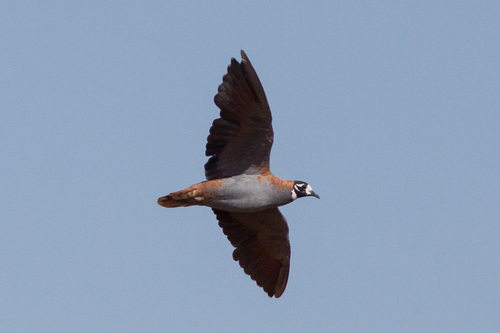
Flock Bronzewing
Phaps histrionica
A true desert nomad, the Flock Bronzewing is a master of survival in Australia's arid heart, known for its stunning harlequin face and massive, synchronized flight patterns.
Quick Identification
Size
Length: 28-31 cm (11-12 in); Wingspan: 55-65 cm (21-25 in); Weight: 230-320 g (8-11 oz)
Colors
Sandy-brown upperparts and grey underparts. Males have a striking black head with a white forehead and a white ring around the ear/throat; females are duller with less distinct facial patterns.
Key Features
- Bold black and white facial mask on males
- Sandy-brown plumage for desert camouflage
- Iridescent green or purple wing patches
- Short, square-tipped tail
When You’ll See Them
Geographic range
Where Does the Flock Bronzewing Live?
The Flock Bronzewing is endemic to the Australian continent, specifically the arid and semi-arid regions of the interior. Its core range covers the vast black-soil plains and grasslands of the Northern Territory and Queensland, reaching down into the northern parts of South Australia and across to the Kimberley in Western Australia. Because they are highly nomadic, they may disappear from a region for years, only to return in the thousands following a significant rain event that triggers grass growth.
Basemap © OpenStreetMap contributors
Behavior
The Flock Bronzewing is one of Australia's most specialized nomadic birds, famously documented by early explorers as occurring in flocks of millions. While modern populations are smaller, they remain highly gregarious, moving in massive, synchronized groups that follow erratic desert rainfall to find seeding grasses. They are remarkably strong fliers, capable of traveling vast distances across the arid interior to reach essential water sources.
On the ground, these pigeons exhibit a cautious but purposeful waddle as they forage. They have a unique drinking habit: rather than landing directly at the water's edge, they often land a short distance away in a large group and wait for a collective 'signal' before rushing to the water to drink rapidly. This behavior is a defense mechanism against raptors that frequent outback waterholes.
EverydayEarth exclusive
Camera Tips
Capturing the Flock Bronzewing on a trail camera is all about 'staking out' the water. In the Australian outback, these birds are tethered to permanent water sources like cattle troughs, bores, or shrinking claypans. Place your camera at the edge of the water, no higher than 20 cm from the ground, aiming across the flat 'landing zone' where the birds gather before drinking. Since they arrive in groups, use a wide-angle lens setting if available to capture the sheer scale of the flock.
Timing is critical for this species. They are most active at the first light of dawn and during the golden hour before sunset. Set your camera's trigger interval to the shortest possible delay, as the birds tend to drink very quickly and depart in a rush. If your camera supports high-speed video, 60fps or higher is ideal to capture the blur of their iridescent 'bronzewing' patches during takeoff.
Because the outback sun can be intense and cause overexposed shots, try to position the camera facing south (in the southern hemisphere) to keep the sun behind the lens. While they are wild birds, they are often less wary of static objects; however, using a camouflaged housing that blends with the red dirt or grey-green saltbush can prevent curious cattle or dingoes from disturbing your setup. If you're setting up on private property or a station, a small scatter of birdseed near the water's edge can encourage the birds to linger long enough for the AI to identify them.
Similar Species
Species that look similar or are commonly confused with Flock Bronzewing.
Frequently Asked Questions
Record Flock Bronzewing at your habitat
Connect a camera to start building your own species record — AI identifies every visitor automatically.