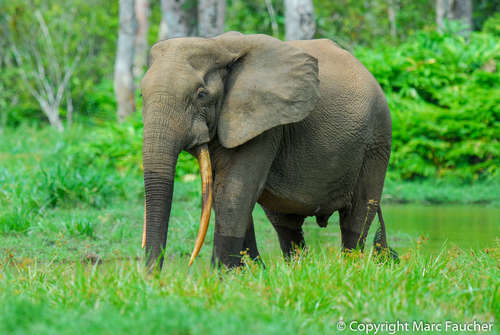
Forest Elephant
Loxodonta cyclotis
Meet the 'Mega-Gardener' of the Congo Basin. Smaller, smarter, and more elusive than their savannah cousins, the Forest Elephant is the hidden heartbeat of Africa's densest jungles.
Quick Identification
Size
Shoulder height: 1.8–2.5 m (6–8 ft); Weight: 2,000–4,000 kg (4,400–8,800 lbs)
Colors
Dull grey skin often covered in red or brown mud; tusks are distinctively straight and pinkish-yellow
Key Features
- Straight, downward-pointing tusks
- Distinctly rounded ears
- Smaller, more compact frame than savannah species
- Typically 5 toenails on front feet and 4 on back
When You’ll See Them
Geographic range
Where Does the Forest Elephant Live?
Native to the lush tropical regions of the African continent, the forest elephant is a specialist of the humid equatorial belt. Its core range is centered in the massive Congo Basin, with the largest and most stable populations found in the dense jungles of Gabon and the Republic of the Congo. Beyond these strongholds, fragmented populations survive in the forests of West Africa, spanning from Côte d'Ivoire to Ghana and Liberia, as well as the mountainous forest regions of Cameroon and the Central African Republic.
Basemap © OpenStreetMap contributors
Behavior
These elephants are ecological powerhouses, often referred to as 'mega-gardeners.' By consuming massive quantities of fruit and traveling long distances, they disperse the seeds of large forest trees that other animals cannot. They are also famous for visiting 'bais'—large, swampy clearings in the forest—where they congregate to socialize and excavate mineral-rich soil with their tusks. Despite their power, they are generally shy and avoid human contact unless provoked or protecting their young.
EverydayEarth exclusive
Camera Tips
Capturing the African Forest Elephant requires a mix of heavy-duty hardware and strategic placement. Look for 'elephant boulevards'—wide, clear-cut trails through the jungle that have been used by generations of elephants. Mount your camera at a height of 2 to 3 meters (6.5 to 10 feet) to keep it out of reach of curious trunks. Forest elephants are extremely tactile and intelligent; they will often investigate, smell, and even attempt to dismantle a camera if it is within reach. Using a steel security box (bear box) and heavy-duty lag bolts is non-negotiable for long-term deployments.
Because the rainforest is notoriously dark, prioritize cameras with high-quality 'No-Glow' infrared flash. Standard white flash or even 'Low-Glow' IR can startle these sensitive animals, potentially leading to a defensive charge against your equipment or causing the herd to abandon the trail. Angle your camera at a 45-degree angle to the trail rather than perpendicular; this allows the sensor more time to trigger as the elephant walks toward the lens, ensuring you get a full-body shot rather than just a grey tail.
Moisture is your biggest enemy in the Congo Basin. Use industrial-grade desiccant packs inside your camera housing to prevent the lens from fogging up in the 90%+ humidity. If you are placing a camera near a 'bai' or mineral lick, set your trigger interval to at least 30 seconds to avoid filling your SD card with thousands of photos of the same lounging herd. For the best educational footage, use 4K video mode—seeing the dexterity of a trunk picking up a single piece of fruit is far more impactful than a static image.
Similar Species
Species that look similar or are commonly confused with Forest Elephant.
Frequently Asked Questions
Record Forest Elephant at your habitat
Connect a camera to start building your own species record — AI identifies every visitor automatically.