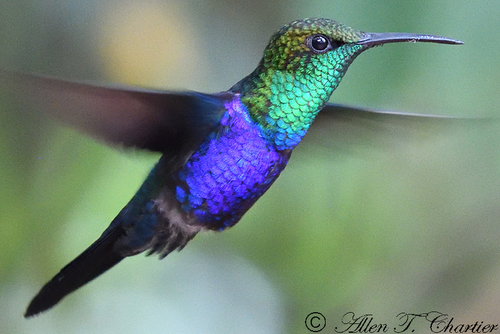
Fork-tailed Woodnymph
Thalurania furcata
With its shimmering emerald throat and deep violet plumage, the Fork-tailed Woodnymph is a jewel of the South American forest. This energetic hummingbird is a frequent visitor to woodland edges and tropical gardens, known for its iconic deeply forked tail.
Quick Identification
Size
Length: 9.5–13 cm (3.7–5.1 in); Wingspan: ~12–15 cm (4.7–5.9 in); Weight: 3.5–6 g (0.12–0.21 oz)
Colors
Males feature a shimmering emerald green throat and crown with deep violet-purple on the belly and back; females are bronzy-green above with pale grayish-white underparts.
Key Features
- Deeply forked, blue-black tail in males
- Vibrant violet-purple patches on the back and belly
- Glistening emerald green throat (gorget)
- Decurved black bill
- Small white spot behind the eye
When You’ll See Them
Geographic range
Where Does the Fork-tailed Woodnymph Live?
This stunning hummingbird is native to the vast tropical regions of South America, boasting one of the most extensive distributions of any woodnymph species. It is found in nearly every country on the continent, with core populations spanning the entire Amazon Basin, the Guianas, and the lush foothills of the Andes. While it is a staple of the Brazilian rainforests and the diverse woodlands of Colombia, Peru, and Bolivia, it is notably absent from the drier landscapes of Chile and Uruguay.
Basemap © OpenStreetMap contributors
Behavior
The Fork-tailed Woodnymph is a spirited and territorial hummingbird known for its bold personality. While they are often found in the lower to middle layers of the forest canopy, they frequently descend to forest edges and clearings to feed. They are known as 'trap-liners,' meaning they follow a regular, repeatable route between nectar-rich flowers throughout the day, ensuring a steady supply of fuel.
Despite their small size, these birds can be fiercely protective of high-quality food sources. Males are particularly aggressive, often performing steep dives and vocalizing sharp chirps to chase away competing hummingbirds or even larger bird species from their preferred blossoms. In a backyard or garden setting, they are inquisitive and may hover near observers to investigate new objects or feeders.
EverydayEarth exclusive
Camera Tips
Capturing the Fork-tailed Woodnymph requires a high-speed camera setup because of their rapid wingbeats and erratic, darting movements. To get the best results, position your AI-powered camera near bright, tubular flowers such as Hibiscus, Heliconia, or Salvia. Since these birds are low-to-midstory dwellers, mount your camera between 3 and 5 feet (1 to 1.5 meters) off the ground, angled slightly upward to capture the brilliant iridescence of the male's violet belly and green throat, which are best seen from a lower perspective.
If using a feeder to attract them, choose one with a perch. While woodnymphs are masters of hovering, they often prefer to land briefly while drinking, which gives your camera's AI more time to lock focus and capture a crisp image. Set your camera to 'Burst Mode' or a high-frame-rate video setting (at least 60fps) to avoid motion blur. Early morning light is the 'golden hour' for woodnymphs; the low-angle sunlight hits their structural feathers perfectly, making the metallic violet and emerald colors pop without the harsh shadows of midday.
For the most natural-looking shots, avoid using red dye in your feeder water and instead use a simple 4:1 water-to-sugar ratio. Ensure the camera is placed in a shaded or semi-shaded area near the edge of a garden or forest line. These birds are most comfortable when they have nearby cover—like a dense shrub or tree—where they can retreat to preen their feathers or scan the area for rival hummingbirds between feeding sessions. If you are in a particularly hot region, place a misting attachment near their favorite flowers; woodnymphs love to fly through the mist to bathe, providing an excellent opportunity for unique action shots.
Similar Species
Species that look similar or are commonly confused with Fork-tailed Woodnymph.
Frequently Asked Questions
Record Fork-tailed Woodnymph at your habitat
Connect a camera to start building your own species record — AI identifies every visitor automatically.