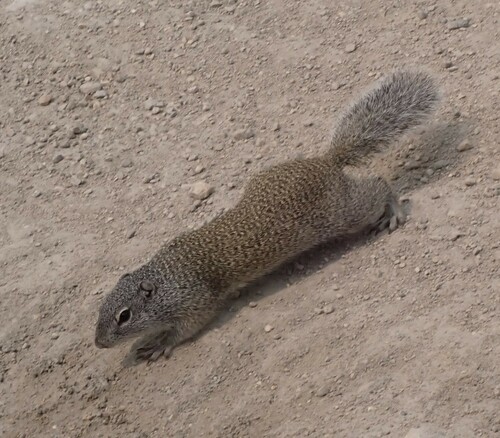
Franklin's Ground Squirrel
Poliocitellus franklinii
The Franklin's Ground Squirrel is a rare gem of the tallgrass prairie, known for its musical whistle and salt-and-pepper coat. This shy, deep-sleeping mammal offers a unique challenge for wildlife watchers and camera trappers alike.
Quick Identification
Size
35-41 cm (14-16 inches) in length; 370-950 g (0.8-2.1 lbs) in weight
Colors
Speckled salt-and-pepper grey-brown back, buff or cream-colored belly, and a dark bushy tail mixed with white hairs.
Key Features
- Long, bushy tail roughly one-third of total body length
- Distinct white ring around the eye
- Salt-and-pepper greyish-brown fur without stripes or spots
- Small, rounded ears set low on the head
When You’ll See Them
Geographic range
Where Does the Franklin's Ground Squirrel Live?
Native to the central plains of North America, the Franklin's Ground Squirrel inhabits a corridor stretching from the Canadian provinces of Alberta, Saskatchewan, and Manitoba down through the Midwestern United States. Its range extends as far south as Kansas and Missouri and as far east as northwestern Indiana. Because it avoids short-grass environments, its presence is often tied to surviving fragments of tallgrass prairie and undisturbed meadowlands across the Great Plains.
Basemap © OpenStreetMap contributors
Behavior
When they are above ground, they spend most of their time foraging or standing in a 'picket-pin' posture to scan for predators. They are notably vocal, producing a clear, bird-like musical whistle that can be easily mistaken for a songbird's call. While they are excellent diggers and live in complex burrow systems, they are also surprisingly agile climbers and will occasionally scale low shrubs to find food or a better vantage point.
EverydayEarth exclusive
Camera Tips
To successfully capture a Franklin's Ground Squirrel on camera, you must target 'edge' habitats where thick, tall grass meets a tree line or a shrubby fence. These squirrels are highly elusive and avoid open areas, so place your camera 6-10 inches off the ground, tucked slightly into the vegetation. Aim the lens at a small clearing within the tall grass or toward a suspected burrow entrance, which is usually about 3 inches wide and hidden under dense cover.
Baiting is highly recommended due to their shy nature. While standard birdseed works, Franklin's Ground Squirrels are more carnivorous than other species; a 'smear' of peanut butter or even a few dried mealworms can be a powerful lure. Position your bait on a flat stone or log to encourage the squirrel to pause and provide a clear, steady shot. Because they are only active for a few months a year, the window between May and July is your best opportunity to get them on film.
Set your AI-powered camera to a high sensitivity with a fast trigger speed, as these squirrels move quickly when they feel exposed. Using video mode (15-30 seconds) is particularly rewarding with this species, as it allows you to record their unique whistling vocalizations and their characteristic tail-flicking behavior. Since they are strictly diurnal, you can save battery life by scheduling the camera to operate only during daylight hours, specifically focusing on sunny, low-wind days when they are most likely to emerge.
Similar Species
Species that look similar or are commonly confused with Franklin's Ground Squirrel.
Frequently Asked Questions
Record Franklin's Ground Squirrel at your habitat
Connect a camera to start building your own species record — AI identifies every visitor automatically.