Freshwater Catfish
Tandanus tandanus
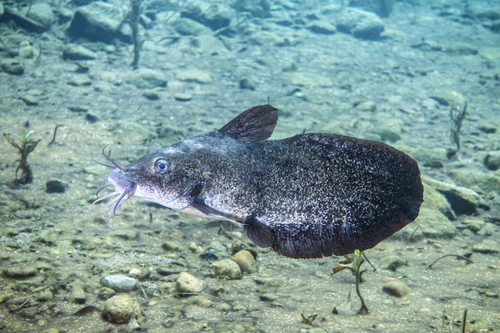
A master of the riverbed, the Freshwater Catfish is famous for its eel-like tail and its incredible skill as an underwater architect. This whiskered Australian native is a fascinating subject for any underwater backyard observer.
Quick Identification
Size
30-50 cm (12-20 in) on average, reaching up to 90 cm (35 in); weighs 1.5-3 kg (3-7 lbs), occasionally up to 7 kg (15 lbs)
Colors
Mottled olive-green, brown, or purplish-black upper body with a cream or white underbelly; juveniles are often more brightly mottled
Key Features
- Eel-like tail tapering to a point
- Four pairs of sensory barbels (whiskers) around the mouth
- Scaleless, slimy skin with a thick mucus layer
- Venomous serrated spines on dorsal and pectoral fins
When You’ll See Them
Geographic range
Where Does the Freshwater Catfish Live?
The Freshwater Catfish is a quintessential Australian species, primarily native to the vast Murray-Darling river system that spans much of the continent's southeast. Beyond this massive basin, they are naturally found in coastal river systems from the eastern tip of the Cape York Peninsula in Queensland all the way down to central Victoria. While they are eastern specialists by nature, human intervention has expanded their footprint, with populations now established in various farm dams and waterways in Western Australia. They prefer the slower, steadier pulses of inland rivers and the tranquil environments of coastal lagoons and billabongs.
Basemap © OpenStreetMap contributors
Behavior
The Freshwater Catfish, often called the 'Tandan,' is a hardy, bottom-dwelling species known for its unusual appearance and industrious nature. Unlike many other catfish, it possesses a continuous fin that runs along its back and around the tail, giving it an eel-like silhouette. They are generally solitary and shy, spending their daylight hours tucked away in hollow logs, undercut banks, or among aquatic vegetation. As dusk approaches, they become much more active, using their sensitive barbels to 'taste' the substrate and locate prey in low-light conditions.
One of their most remarkable behaviors is their nesting ritual. During the breeding season, the male becomes an architect, meticulously clearing a circular area of the riverbed and carrying pebbles and gravel in his mouth to construct a mound-shaped nest. He then stays to guard the eggs and fanned them with his fins to keep them oxygenated. While they are generally peaceful, they can be territorial during this period and will use their venomous spines as a last resort defense if threatened by predators or handled carelessly by humans.
EverydayEarth exclusive
Camera Tips
Capturing the Freshwater Catfish on camera requires a specialized approach since they are entirely aquatic. If you have a backyard pond or live near a creek, an underwater action camera or a waterproof trail camera is essential. Position your camera on a weighted tripod or secure it to a heavy submerged log, aiming the lens toward sandy or gravelly clearings. This species is most active at night and during the twilight hours, so ensure your camera has high-quality infrared (IR) night vision to cut through murky water without spooking the fish.
To attract a Freshwater Catfish to your lens, place a small mesh bait bag filled with smelly attractants like prawns, worms, or crushed snails just inside the camera's field of view. Be sure to secure the bait bag to a fixed object so the fish doesn't drag it out of frame. If you are filming in a river, aim the camera slightly downstream to prevent floating debris from collecting on the lens, and try to find a spot with slow-moving water or a deep pool where catfish congregate during the day.
Spring and early summer are the best times for filming unique behaviors. During this period, males become industrious architects, clearing circular depressions in the riverbed and carrying pebbles in their mouths to build nests. If you spot a mound of gravel about 50cm to 100cm wide in the shallows, place your camera nearby at a respectful distance. You may capture the fascinating parental care and nest maintenance that makes this species so unique among Australian fish.
Similar Species
Species that look similar or are commonly confused with Freshwater Catfish.
Frequently Asked Questions
Record Freshwater Catfish at your habitat
Connect a camera to start building your own species record — AI identifies every visitor automatically.