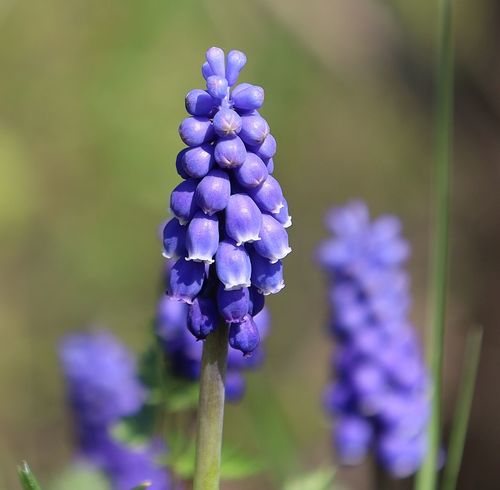
Garden Grape-hyacinth
Muscari armeniacum
A vibrant herald of spring, the Garden Grape-hyacinth blankets the earth in stunning cobalt blue. These hardy Mediterranean natives are more than just pretty flowers; they are a vital early-season lifeline for backyard pollinators.
Quick Identification
Size
Height 15-20 cm (6-8 in); spread 5-10 cm (2-4 in)
Colors
Dusky cobalt blue to deep violet flowers, often with white-rimmed 'teeth' at the opening; bright green strap-like leaves
Key Features
- Tight, conical clusters of urn-shaped blue flowers resembling a bunch of grapes
- Narrow, fleshy green leaves that often appear in autumn
- Tiny white circular rims at the mouth of each individual flower bell
- Low-growing habit, rarely exceeding 8 inches in height
When You’ll See Them
Geographic range
Where Does the Garden Grape-hyacinth Live?
Native to the Eastern Mediterranean and Western Asia, the Garden Grape-hyacinth's ancestral home spans from Greece and Turkey through the Caucasus mountains into Armenia. Due to its popularity in horticulture, it has successfully naturalized across much of temperate Europe and North America. In these regions, it is frequently found escaping garden borders into nearby grassy banks, meadows, and deciduous forest edges.
Basemap © OpenStreetMap contributors
Behavior
The Garden Grape-hyacinth is a hardy perennial bulb known for its rapid growth and early spring emergence. Unlike many other spring bulbs that wait for the thaw, Muscari armeniacum often sends up its foliage in the late autumn, staying green through the winter before producing flowers in March or April. The blooms last for three to four weeks, providing a critical early-season nectar source for emerging queen bees and early butterflies.
In the garden, these plants are highly social, quickly forming dense carpets through both seed dispersal and the production of 'bulblets' (offset bulbs). While they are stationary, they exhibit 'sleep movements' or nyctinasty, where flowers may subtly shift in response to light and temperature. After blooming, the plant enters a period of dormancy, with the foliage yellowing and disappearing by mid-summer as the bulb stores energy for the following year.
EverydayEarth exclusive
Camera Tips
To capture the best images of Garden Grape-hyacinth, your camera needs to be positioned much lower than it would be for backyard mammals. Place your AI-powered camera on a small tripod or directly on the ground, angled slightly upward. This 'worm's-eye view' emphasizes the architectural detail of the flower clusters and makes the small plants look like a towering blue forest. Because they are low-growing, ensure you clear away any dead brown leaves or tall grass from the immediate foreground to prevent the autofocus from locking onto the wrong subject.
If your camera has a time-lapse feature, this is the perfect species for it. Set the interval to capture a frame every 30 minutes over a period of two weeks in early spring. You will be able to see the 'grape' clusters elongate and the individual bells open from the bottom of the stem upward. For lighting, the deep blue pigment of the petals is best captured during the 'golden hour' shortly after sunrise or before sunset, which avoids the harsh glare of midday sun that can wash out the rich violet tones.
Since these flowers are magnets for pollinators, use a high-speed trigger setting if your camera supports it. Early-season bumblebees and bee flies are frequent visitors. Position the camera about 12-18 inches away from a healthy cluster to catch these insects in action. No bait is needed for the plant itself, but ensuring the soil is slightly damp will make the flowers look more turgid and vibrant on camera, especially during dry spring spells.
Similar Species
Species that look similar or are commonly confused with Garden Grape-hyacinth.
Frequently Asked Questions
Record Garden Grape-hyacinth at your habitat
Connect a camera to start building your own species record — AI identifies every visitor automatically.