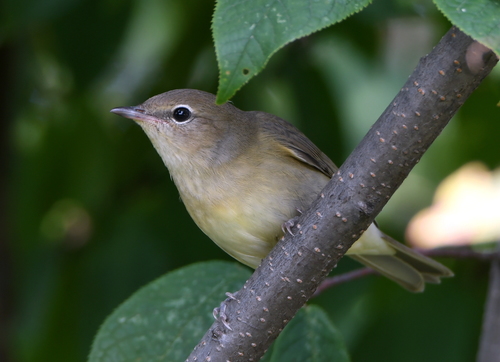
Garden Warbler
Sylvia borin
The master of disguise in the bird world, the Garden Warbler trades bright colors for a beautiful, flute-like song. Discover how to spot this elusive visitor in your backyard thickets.
Quick Identification
Size
Length 14 cm (5.5 in), wingspan 20–23 cm (8–9 in), weight 16–22 g (0.5–0.8 oz)
Colors
Uniform olive-brown upperparts and dull buff-white underparts; lead-grey legs and a short, thick grey bill. Sexes are identical.
Key Features
- Remarkably plain plumage with no striking streaks or bars
- Distinctive pale grey patch on the side of the neck
- Short, stout bill compared to other warblers
- Indistinct pale eye-ring and faint pale stripe above the eye
When You’ll See Them
Geographic range
Where Does the Garden Warbler Live?
The Garden Warbler is native to a vast stretch of the Palearctic, breeding across nearly all of Europe and extending through Western Siberia. This migratory species spends its winters in sub-Saharan Africa, traveling thousands of miles twice a year. While they are widespread across the United Kingdom and continental Europe, they are absent from the northernmost parts of Scandinavia and the driest regions of the Mediterranean. They are common summer visitors to temperate forests and lush suburban green spaces before they vanish southward in late August.
Basemap © OpenStreetMap contributors
Behavior
The Garden Warbler is often described as the 'plain Jane' of the bird world, but what it lacks in flashiness, it makes up for in its beautiful, liquid song. These birds are notorious 'skulkers,' preferring to stay hidden within dense foliage, brambles, and thickets. Unlike their bold relatives, they are rarely seen out in the open, usually moving through the shadows with a deliberate, quiet grace as they search for insects.
Despite their shy nature, they are highly territorial during the breeding season. You are far more likely to hear their rich, melodic warble—which can last for several seconds without a break—than you are to see them. In the late summer, their behavior shifts as they prepare for migration; they become less vocal and more focused on gorging themselves on sugar-rich berries to fuel their long journey south.
EverydayEarth exclusive
Camera Tips
Capturing a Garden Warbler on camera requires patience and strategic placement because of their secretive nature. Because they avoid open spaces, avoid placing your camera in the middle of a lawn. Instead, mount your camera at a height of 3 to 5 feet, angled directly into a dense shrub or a 'wild' corner of your garden where brambles or ivy are present. This is their natural highway, and they are much more likely to trigger your AI camera while hopping between branches.
Water is the absolute best lure for this species. A bird bath placed near cover is a magnet for Garden Warblers, especially during dry spells in May and June. Ensure the camera is positioned to capture the surface of the water, as these birds often take quick, nervous baths. Since they are so plain, high-resolution settings are essential to distinguish their subtle grey neck patch and stout bill from other similar-looking warblers.
In late summer (August), move your camera near fruit-bearing plants like elderberry, honeysuckle, or blackberry bushes. Garden Warblers become much less shy when there is ripe fruit available, and they will spend more time in front of the lens while feeding. Set your camera to take bursts of photos or short videos, as their movements are quick and 'twitchy'—multiple shots ensure you get at least one clear frame for identification.
Similar Species
Species that look similar or are commonly confused with Garden Warbler.
Frequently Asked Questions
Record Garden Warbler at your habitat
Connect a camera to start building your own species record — AI identifies every visitor automatically.