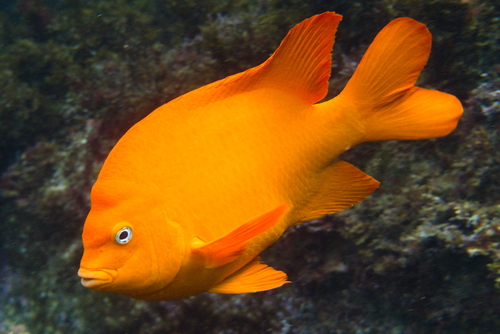
Garibaldi
Hypsypops rubicundus
The Garibaldi is the golden icon of the California coast, a brilliant orange sentinel that guards the emerald kelp forests with surprising ferocity.
Quick Identification
Size
Typically 25 to 36 cm (10 to 14 inches) in length; weights up to 0.9 kg (2 lbs)
Colors
Adults are a brilliant, uniform neon-orange; juveniles are orange with iridescent electric-blue spots and fin edges
Key Features
- Vivid, solid orange coloration across the entire body
- Deep, laterally compressed body with a heart-shaped tail
- Large, expressive eyes and a small, protruding mouth
- Aggressive, territorial behavior toward divers and other fish
When You’ll See Them
Sightings on EverydayEarth
Mar 31, 2026
A group of bright orange Garibaldi swim actively through the kelp forest. A large California Sheephead enters from the right and cruises across the foreground, showing its characteristic white chin before disappearing off-screen to the left.
Jul 30, 2026
A vibrant underwater scene shows several fish species active around large pier pilings. Bright orange Garibaldi swim prominently between the columns, while schools of small, dark Blacksmith Chromis dart through the open water. A mottled Kelp Bass is also visible cruising through the lower portion of the frame.
Jul 26, 2026
A vibrant underwater scene showing a variety of fish swimming among barnacle-encrusted pier pilings. Several Kelp Bass cruise near the structures, while bright orange Garibaldi and a large male California Sheephead move through the background. Schools of small, dark Blacksmith are scattered throughout the water column.
Jul 25, 2026
A diverse community of temperate reef fish swims among large, encrusted pier pilings. A large California Sheephead and several bright orange Garibaldi are prominent as they navigate the water column, while schools of Blacksmith and individual Kelp Bass drift in the background and between the structures.
Jul 25, 2026
A vibrant orange Garibaldi swims through the center of the frame, navigating between large pier pilings. In the background, a large school of small, dark Blacksmith Chromis drifts in the current. A male California Sheephead briefly enters and exits the frame on the left side.
Jul 24, 2026
Sunlight filters through the water column between massive pier pilings in Big Fisherman Cove. A diverse community of temperate reef fish is active, including bright orange Garibaldi and a large male California Sheephead that swims directly toward and past the lens. Several Kelp Bass hover in the current, while a school of small Blacksmith moves in the background.
Geographic range
Where Does the Garibaldi Live?
Native to the subtropical eastern Pacific Ocean, the Garibaldi is a quintessential resident of the California coast. Its primary range extends from Monterey Bay in Northern California down to the southern tip of Baja California, Mexico, including several offshore islands like the Channel Islands and Guadalupe Island. While they are most densely concentrated in the warm, clear waters south of Point Conception, they are the iconic golden residents of the Southern California bight.
Basemap © OpenStreetMap contributors
Recorded on EverydayEarth
Behavior
The Garibaldi is a fiercely territorial member of the damselfish family, known for its bold personality and striking appearance. Unlike many fish that flee when approached, the Garibaldi often stands its ground, sometimes even charging at divers or larger animals that wander too close to its established territory. During the breeding season, males become particularly industrious, meticulously "gardening" a patch of reef by clearing away all organisms except for specific species of red algae, which serve as a soft bed for the female's eggs.
These fish are generally solitary and maintain a strict home range among the rocky crevices of kelp forests. They communicate through thumping sounds produced by grinding their teeth together, a noise often heard by divers when the fish is defending its space. While they are mostly indifferent to humans, their curiosity and lack of fear make them one of the most frequently photographed species in the Pacific shallows.
EverydayEarth exclusive
Camera Tips
Capturing the Garibaldi on an underwater trail camera or a stationary GoPro requires finding the right 'territory' rather than using bait. Look for vertical rock faces or crevices within kelp forests that appear unusually clean or have a concentrated patch of velvety red algae; this is likely a male's nest site. Mount your camera to a weighted base or a stable rock using a suction or clamp mount, ensuring it is positioned about 2 to 3 feet away from the nest to avoid causing excessive stress while still catching the action.
Because of their brilliant orange hue, Garibaldi often 'blow out' in high-contrast sunlight near the surface. To get the best color, set your camera to a slightly lower exposure compensation (-0.5 or -1.0) and use a red filter if you are deeper than 15 feet to bring back the warm tones lost in the water column. If your camera supports it, shoot at 60fps or higher to capture their quick, jerky territorial displays and the way they fan their nests with their pectoral fins.
Since Garibaldi are protected by law in California, never use food or attractants to lure them. Instead, rely on their natural curiosity; they will often approach a stationary camera to inspect the lens, providing excellent close-up shots. Early afternoon provides the best light penetration in kelp forests, creating 'god rays' that can make your footage look cinematic against the fish's glowing orange scales.
Similar Species
Species that look similar or are commonly confused with Garibaldi.
California Sheephead (Female)
Females are duller pinkish-orange and have a more elongated body and a white chin, whereas Garibaldi are bright neon-orange and more disc-shaped.
Goldfish
While similar in color, goldfish are freshwater species and lack the deep, compressed body and marine habitat of the Garibaldi.
Frequently Asked Questions
Record Garibaldi at your habitat
Connect a camera to start building your own species record — AI identifies every visitor automatically.